


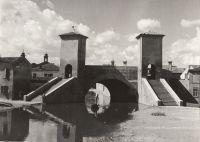


"Ravenna. [Sar]cofagi che [la] tradizione [at]tribuiva [a Galla Pla]cidia, mer[avi]glio[samen]te i[ll]uminati. La lune[tta mostra s]una gra[ticola e il] martir[e S. Lorenzo]"
(Ravenna. Sarcophagi traditionally attributed to Galla Placidia, wonderfully illuminated. The lunette shows a gridiron and the martyr St. Lawrence)
gelatin silver print
stamp verso
Photograph from a collection of tourism photographs from the first half of the 20th century, issued by Italian tourism boards. High-quality works by renowned studios, such as the Alinari brothers, were frequently used to promote Italy as a travel destination. With the West German Economic Miracle (Wirtschaftswunder) of the 1950s, these idealized images of longing became a reality: rising prosperity and increased leisure time transformed vacations into a status symbol. Italy – particularly the Riviera and the Adriatic coast – became the number one destination of choice. By the mid-1950s, 4.5 million Germans were already traveling across the Alps, marking the beginning of modern mass tourism.1
The Mausoleo di Galla Placidia in Ravenna is one of the most significant monuments of late antique mosaic art worldwide. Erected in the 5th century, the cross-shaped structure is striking in its interior for its barrel vaults and central pendentive dome, which are completely covered in magnificent mosaics. An absolute highlight of the interior is the deep blue vault, interwoven with stars and ornaments, which thrones above the central sarcophagus. The detailed depictions of saints, apostles, and Christian symbols reflect the theological and artistic golden age of the former Western Roman imperial residence. Inscribed as a UNESCO World Heritage Site, the building is captivating for the mystical light atmosphere created by its narrow alabaster windows.
Founded in Bologna in 1914 by Achille Villani, the Fotostudio A. Villani & Figli is an important archive for architectural and documentary photography in Italy. The institution achieved renown through its masterfully crafted and systematic recording of the art and cultural heritage of Emilia-Romagna. In the 1950s, the studio served as a key partner for the provincial tourism boards (EPT), decisively shaping the visual promotion of northern Italy with its high-contrast, precisely composed photographs. In 1988, the studio's invaluable historical legacy of over 670,000 photographs was transferred to the central picture archive of Fratelli Alinari in Florence.
(Christoph Fuchs)
Note
1
"Geteiltes Deutschland: Modernisierung. Bundesrepublik im Wandel. Tourismus", Lebendiges Museum online, Deutsches Historisches Museum, https://www.hdg.de/lemo/kapitel/geteiltes-deutschland-modernisierung/bundesrepublik-im-wandel/tourismus.html (accessed 26.6.2026)
![S-3111, "Ravenna. [Sar]cofagi che [la] tradizione [at]tribuiva [a Galla Pla]cidia, mer[avi]glio[samen]te i[ll]uminati. La lune[tta mostra s]una gra[ticola e il] martir[e S. Lorenzo]"](/y/images/Hauptansichten/S_3111_full.jpg)
S-3111, Front view
© A. Villani & Figli
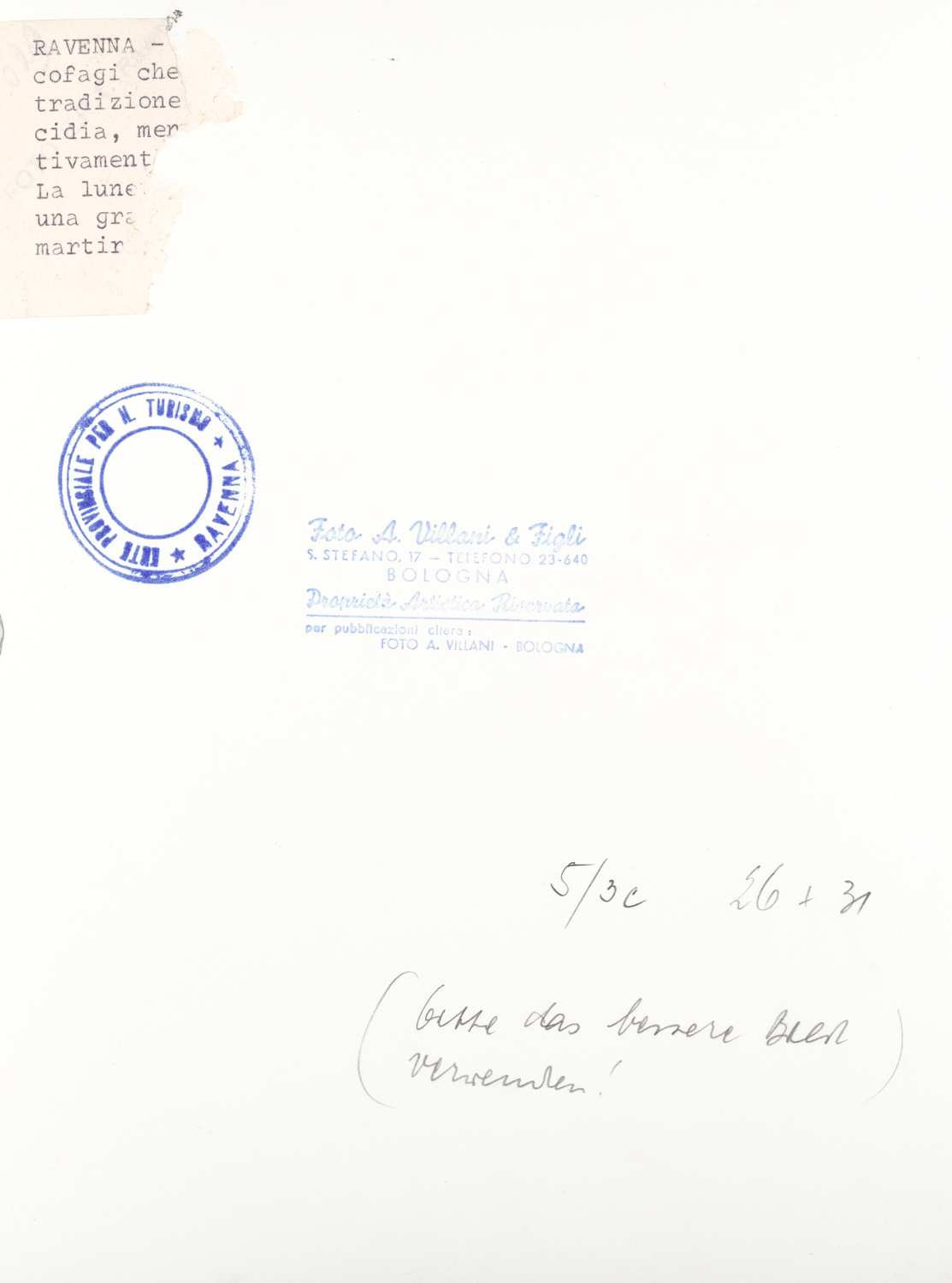
S-3111, view verso

© A. Villani & Figli

© A. Villani & Figli

© A. Villani & Figli

© A. Villani & Figli

© A. Villani & Figli


© A. Villani & Figli


© A. Villani & Figli


© A. Villani & Figli

© A. Villani & Figli

© A. Villani & Figli

© A. Villani & Figli


© A. Villani & Figli

© A. Villani & Figli

© A. Villani & Figli

© A. Villani & Figli

© A. Villani & Figli