


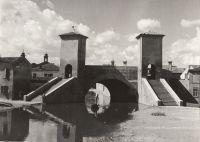


"Ravenna. Mausoleo di Teodorico"
gelatin silver print
stamp verso
Photograph from a collection of tourism photographs from the first half of the 20th century, issued by Italian tourism boards. High-quality works by renowned studios, such as the Alinari brothers, were frequently used to promote Italy as a travel destination. With the West German Economic Miracle (Wirtschaftswunder) of the 1950s, these idealized images of longing became a reality: rising prosperity and increased leisure time transformed vacations into a status symbol. Italy – particularly the Riviera and the Adriatic coast – became the number one destination of choice. By the mid-1950s, 4.5 million Germans were already traveling across the Alps, marking the beginning of modern mass tourism.1
The Mausoleo di Teodorico in Ravenna is a unique monument of late antique architecture. Erected around 520 AD as the personal burial place of the Ostrogothic king Theodoric the Great, the structure is striking for its two-story, decagonal structure made of white Istrian limestone. An absolute highlight and an unsolved riddle of ancient engineering is the monumental, monolithic roof. Carved from a single block of stone weighing around 230 tons, the dome was placed onto the upper structure without the use of mortar. Inscribed as a UNESCO World Heritage Site since 1996, the building embodies the fusion of Roman building traditions with Germanic influences through its massive, monolithic aesthetic.
Founded in Bologna in 1914 by Achille Villani, the Fotostudio A. Villani & Figli is an important archive for architectural and documentary photography in Italy. The institution achieved renown through its masterfully crafted and systematic recording of the art and cultural heritage of Emilia-Romagna. In the 1950s, the studio served as a key partner for the provincial tourism boards (EPT), decisively shaping the visual promotion of northern Italy with its high-contrast, precisely composed photographs. In 1988, the studio's invaluable historical legacy of over 670,000 photographs was transferred to the central picture archive of Fratelli Alinari in Florence.
(Christoph Fuchs)
Note
1
"Geteiltes Deutschland: Modernisierung. Bundesrepublik im Wandel. Tourismus", Lebendiges Museum online, Deutsches Historisches Museum, https://www.hdg.de/lemo/kapitel/geteiltes-deutschland-modernisierung/bundesrepublik-im-wandel/tourismus.html (accessed 26.6.2026)

S-3110, Front view
© A. Villani & Figli
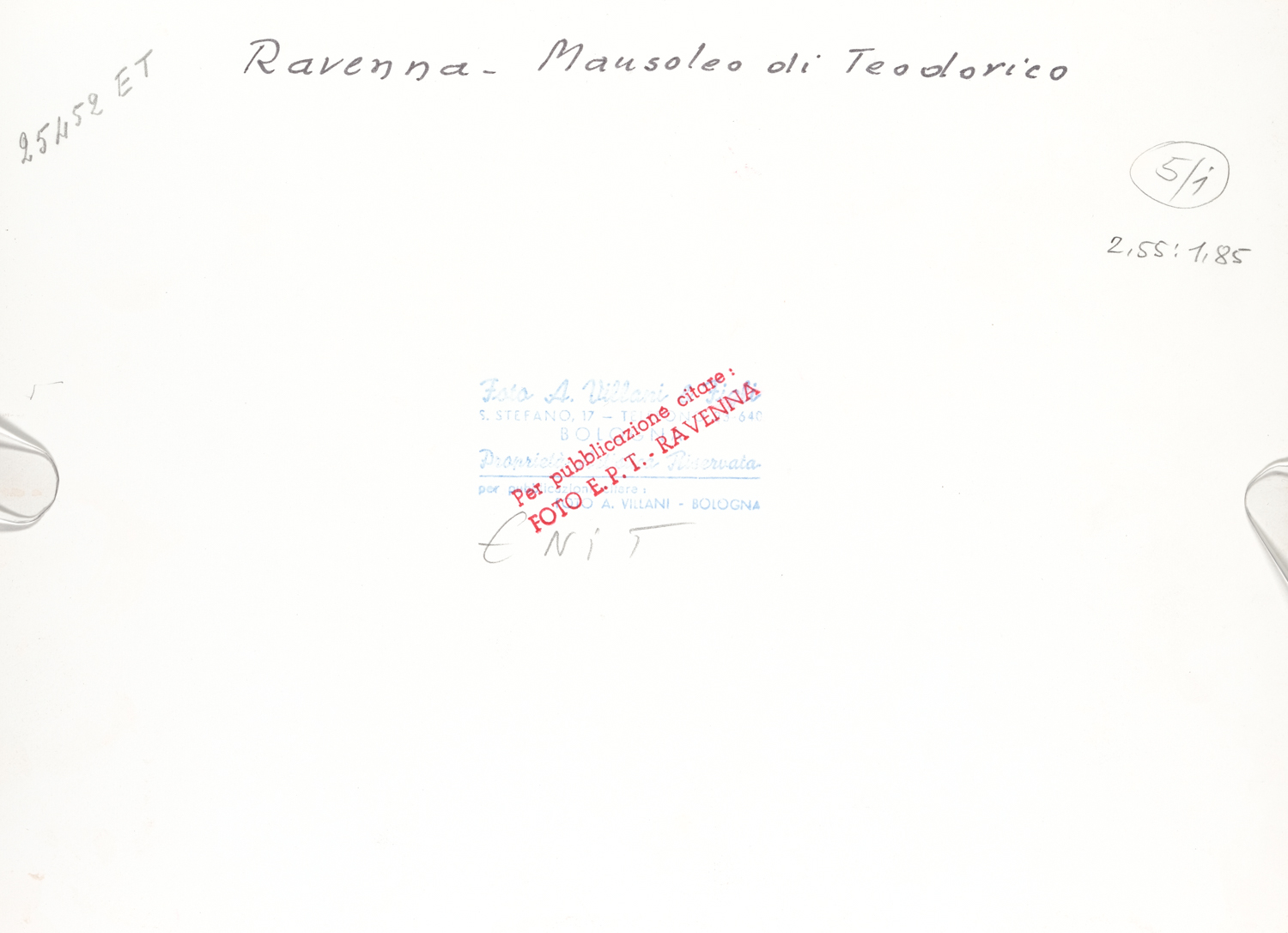
S-3110, view verso

© A. Villani & Figli

© A. Villani & Figli

© A. Villani & Figli

© A. Villani & Figli

© A. Villani & Figli


© A. Villani & Figli


© A. Villani & Figli


© A. Villani & Figli

© A. Villani & Figli

© A. Villani & Figli

© A. Villani & Figli


© A. Villani & Figli

© A. Villani & Figli
![S-3111, Achille Villani & Figli, "Ravenna. [Sar]cofagi che [la] tradizione [at]tribuiva [a Galla Pla]cidia, mer[avi]glio[samen]te i[ll]uminati. La lune[tta mostra s]una gra[ticola e il] martir[e S. Lorenzo]", 1950s](/y/images/Hauptansichten/S_3111_full.jpg)
© A. Villani & Figli

© A. Villani & Figli

© A. Villani & Figli