


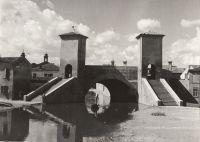


"Abbazia di Montevileto Maggiore"
gelatin silver print
stamp verso
Photograph from a collection of tourism photographs from the first half of the 20th century, issued by Italian tourism boards. High-quality works by renowned studios, such as the Alinari brothers, were frequently used to promote Italy as a travel destination. With the West German Economic Miracle (Wirtschaftswunder) of the 1950s, these idealized images of longing became a reality: rising prosperity and increased leisure time transformed vacations into a status symbol. Italy – particularly the Riviera and the Adriatic coast – became the number one destination of choice. By the mid-1950s, 4.5 million Germans were already traveling across the Alps, marking the beginning of modern mass tourism.1
The distant view of the Abbazia di Santa Maria di Monte Oliveto Maggiore documents the exposed position of the monastic complex within the Tuscan landscape. Erected amidst dense forests and steep slopes, the structure is striking for its defensive, castle-like architecture, which is surmounted by the slender campanile of the abbey church. The monumental brick buildings blend as a self-contained ensemble into the natural backdrop south of Siena, characterized by erosion and cypress groves. The photograph illustrates the principle of seclusion and solitude deliberately chosen by the monks in the midst of an untamed nature.
(Christoph Fuchs)
Note
1
"Geteiltes Deutschland: Modernisierung. Bundesrepublik im Wandel. Tourismus", Lebendiges Museum online, Deutsches Historisches Museum, https://www.hdg.de/lemo/kapitel/geteiltes-deutschland-modernisierung/bundesrepublik-im-wandel/tourismus.html (accessed 26.6.2026)

S-3109, Front view
© Foto Grassi

S-3109, view verso

© Foto Grassi

© Foto Grassi

© Foto Grassi

© Foto Grassi

© Foto Grassi


© Foto Grassi


© Foto Grassi

© Foto Grassi

© Foto Grassi


© Foto Grassi

© Foto Grassi
![S-3111, Achille Villani & Figli, "Ravenna. [Sar]cofagi che [la] tradizione [at]tribuiva [a Galla Pla]cidia, mer[avi]glio[samen]te i[ll]uminati. La lune[tta mostra s]una gra[ticola e il] martir[e S. Lorenzo]", 1950s](/y/images/Hauptansichten/S_3111_full.jpg)
© Foto Grassi

© Foto Grassi

© Foto Grassi