


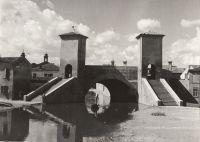


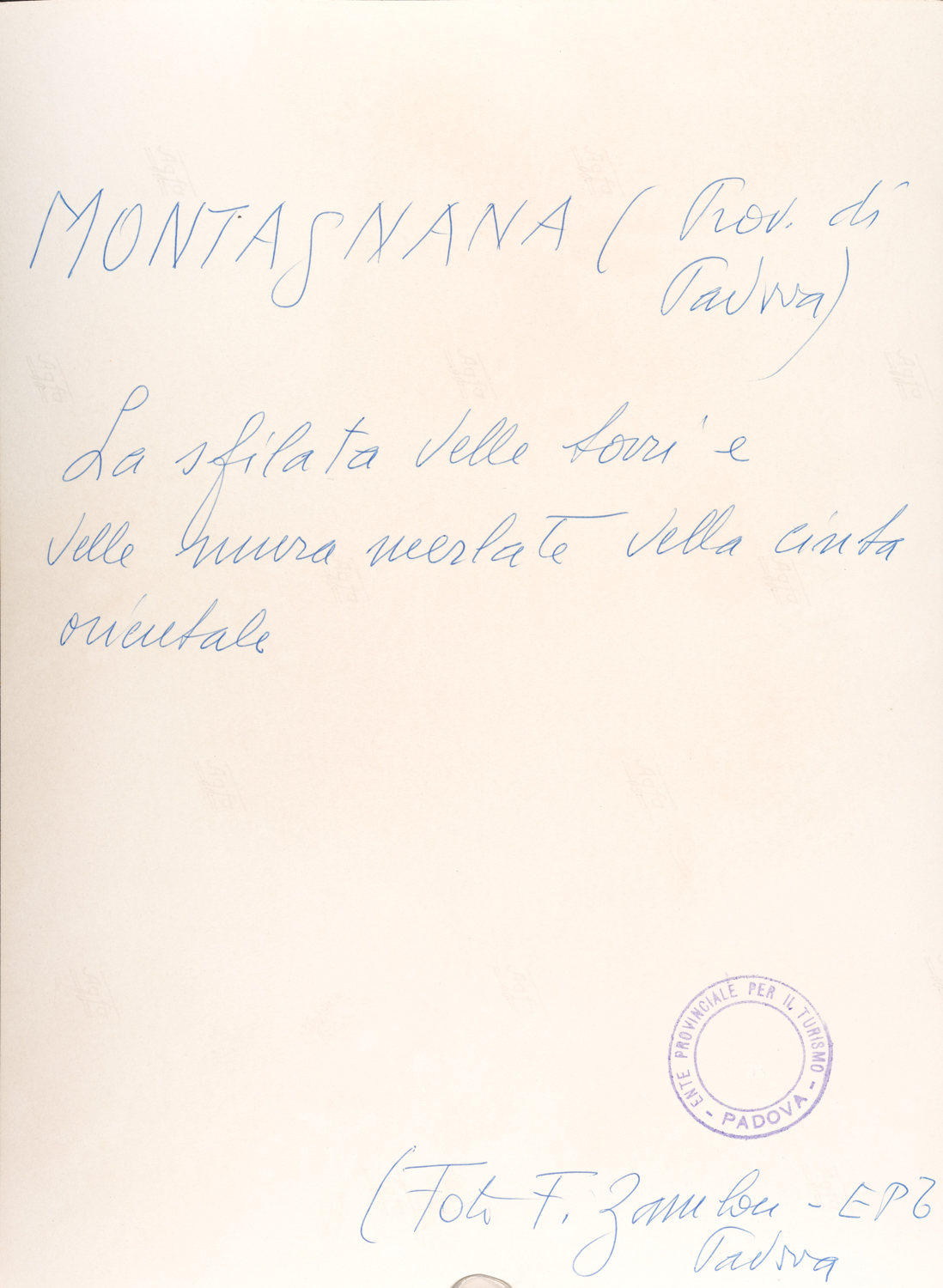
"Montagnana (Prov. di Padova). La sfilata delle torri e delle mura merlate della cinta orientale"
(Montagnana, Prov. of Padua. The row of towers and crenellated walls of the eastern ring)
gelatin silver print
stamp verso
Photograph from a collection of tourism photographs from the first half of the 20th century, issued by Italian tourism boards. High-quality works by renowned studios, such as the Alinari brothers, were frequently used to promote Italy as a travel destination. With the West German Economic Miracle (Wirtschaftswunder) of the 1950s, these idealized images of longing became a reality: rising prosperity and increased leisure time transformed vacations into a status symbol. Italy – particularly the Riviera and the Adriatic coast – became the number one destination of choice. By the mid-1950s, 4.5 million Germans were already traveling across the Alps, marking the beginning of modern mass tourism.1
The medieval town walls of Montagnana are considered one of the best-preserved military fortifications in Europe. Erected in the 14th century from brick and quarry stone under the rule of the Carrara family, the defensive wall encircles the historic old town over a length of around two kilometers. The structure is striking for its monumental height of up to eight meters, its characteristic swallowtail battlements, and a total of 24 square defensive towers. A deep moat, which is still partially water-bearing today, surrounds the entire complex, reflecting the defensibility of the former border fortress.
(Christoph Fuchs)
Note
1
"Geteiltes Deutschland: Modernisierung. Bundesrepublik im Wandel. Tourismus", Lebendiges Museum online, Deutsches Historisches Museum, https://www.hdg.de/lemo/kapitel/geteiltes-deutschland-modernisierung/bundesrepublik-im-wandel/tourismus.html (accessed 26.6.2026)

S-3102, Front view
S-3102, view verso


![S-3111, Achille Villani & Figli, "Ravenna. [Sar]cofagi che [la] tradizione [at]tribuiva [a Galla Pla]cidia, mer[avi]glio[samen]te i[ll]uminati. La lune[tta mostra s]una gra[ticola e il] martir[e S. Lorenzo]", 1950s](/y/images/Hauptansichten/S_3111_full.jpg)

