


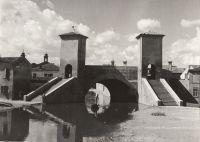


"Certaldo. Palazzo Pretorio"
gelatin silver print
stamp verso
Photograph from a collection of tourism photographs from the first half of the 20th century, issued by Italian tourism boards. High-quality works by renowned studios, such as the Alinari brothers, were frequently used to promote Italy as a travel destination. With the West German Economic Miracle (Wirtschaftswunder) of the 1950s, these idealized images of longing became a reality: rising prosperity and increased leisure time transformed vacations into a status symbol. Italy – particularly the Riviera and the Adriatic coast – became the number one destination of choice. By the mid-1950s, 4.5 million Germans were already traveling across the Alps, marking the beginning of modern mass tourism.1
The Palazzo Pretorio in Certaldo Alto is one of the most significant secular buildings in central Tuscany. Erected in the 12th century and expanded in the 15th century, the structure served as the seat of government for the Florentine vicars who administered the region. The characteristic brick facade, complete with battlements, a bell tower, and a clock, is richly adorned with coat-of-arms reliefs made of ceramic, marble, and stone. These heraldic emblems were left behind by the respective vicars upon departing from office.
(Christoph Fuchs)
Note
1
"Geteiltes Deutschland: Modernisierung. Bundesrepublik im Wandel. Tourismus", Lebendiges Museum online, Deutsches Historisches Museum, https://www.hdg.de/lemo/kapitel/geteiltes-deutschland-modernisierung/bundesrepublik-im-wandel/tourismus.html (accessed 26.6.2026)

S-3098, Front view
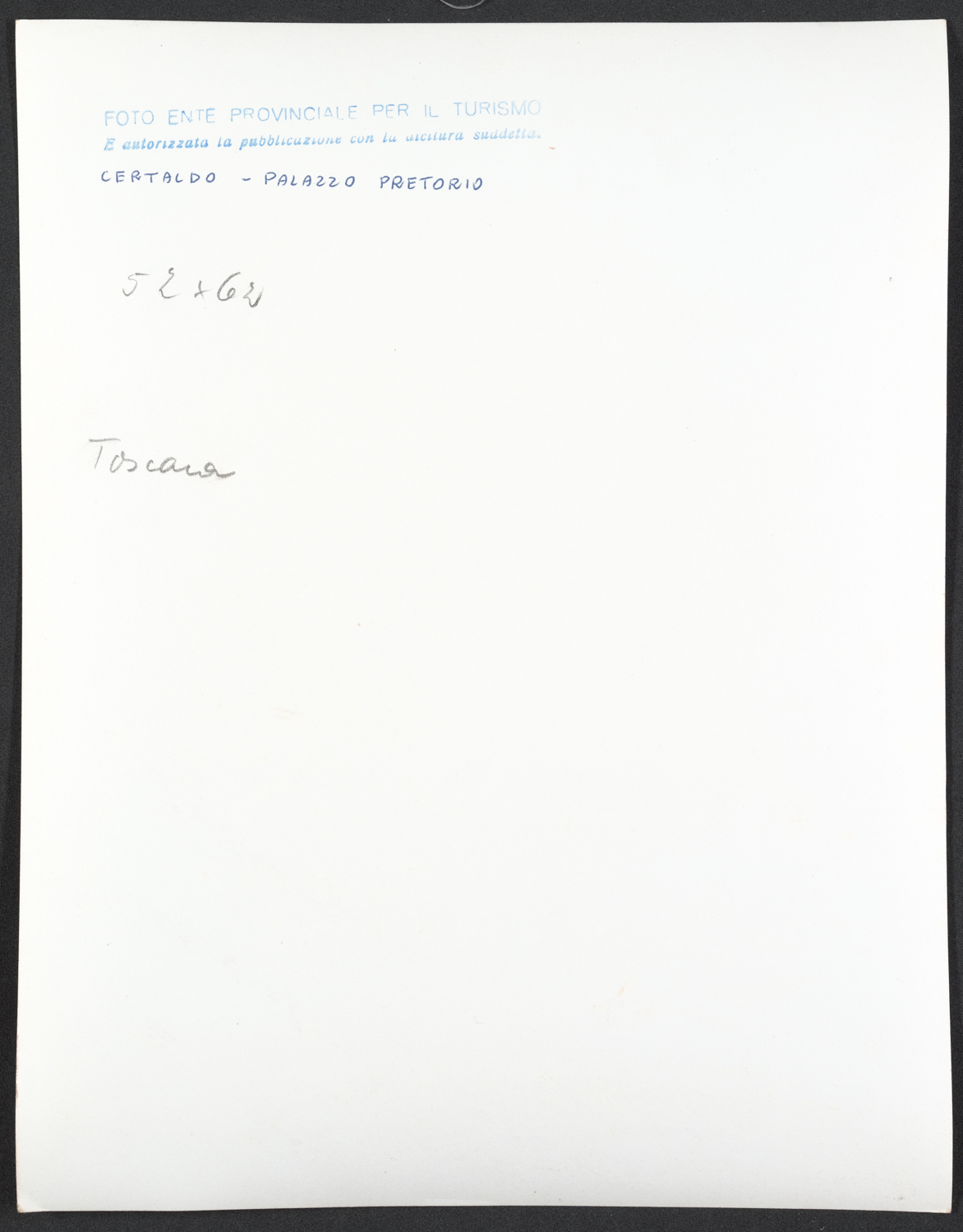
S-3098, view verso


![S-3111, Achille Villani & Figli, "Ravenna. [Sar]cofagi che [la] tradizione [at]tribuiva [a Galla Pla]cidia, mer[avi]glio[samen]te i[ll]uminati. La lune[tta mostra s]una gra[ticola e il] martir[e S. Lorenzo]", 1950s](/y/images/Hauptansichten/S_3111_full.jpg)

