


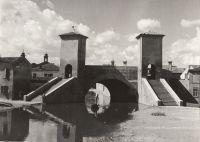


"Pisa. Santa Maria della Spina"
gelatin silver print
stamp verso
Photograph from a collection of tourism photographs from the first half of the 20th century, issued by Italian tourism boards. High-quality works by renowned studios, such as the Alinari brothers, were frequently used to promote Italy as a travel destination. With the West German Economic Miracle (Wirtschaftswunder) of the 1950s, these idealized images of longing became a reality: rising prosperity and increased leisure time transformed vacations into a status symbol. Italy – particularly the Riviera and the Adriatic coast – became the number one destination of choice. By the mid-1950s, 4.5 million Germans were already traveling across the Alps, marking the beginning of modern mass tourism.1
The church of Santa Maria della Spina in Pisa is considered one of the most delicate masterpieces of Gothic architecture in all of Europe. Erected starting in 1230 as a small oratory directly on the banks of the Arno, the structure is captivating for its exceedingly rich and intricate exterior decoration, crowned by numerous pinnacles, tabernacles, and sculptures by prominent masters. It received its name, the "Church of the Thorn," in 1333 following the acquisition of a highly revered relic, believed to be a thorn from Christ's crown of thorns. Due to recurring flood damage and the acute threat posed by the riverbed, the church was completely dismantled in 1871, raised by one meter, and faithfully rebuilt at its current, secure location on the Lungarno.
(Christoph Fuchs)
Note
1
"Geteiltes Deutschland: Modernisierung. Bundesrepublik im Wandel. Tourismus", Lebendiges Museum online, Deutsches Historisches Museum, https://www.hdg.de/lemo/kapitel/geteiltes-deutschland-modernisierung/bundesrepublik-im-wandel/tourismus.html (accessed 26.6.2026)

S-3095, Front view
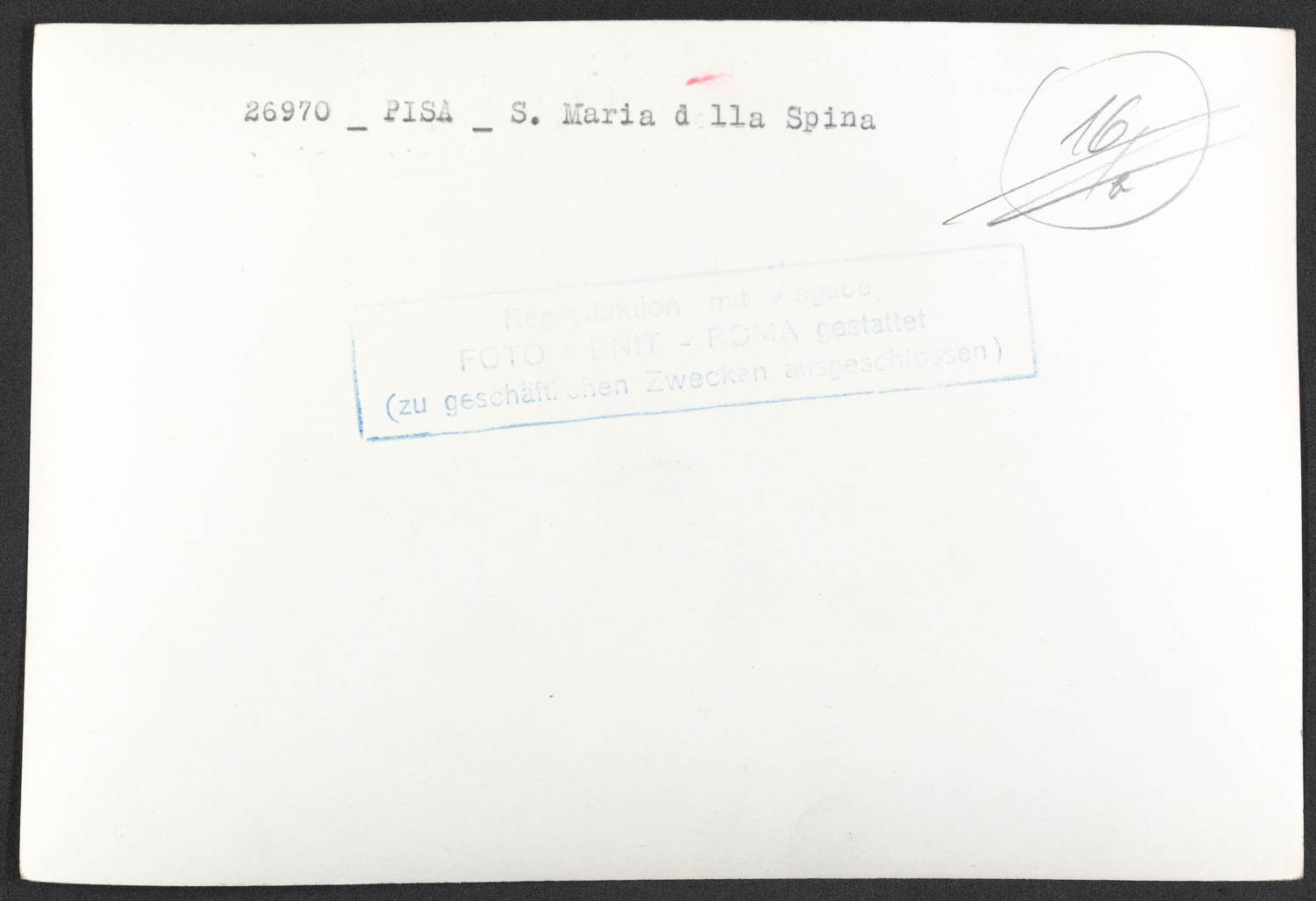
S-3095, view verso


![S-3111, Achille Villani & Figli, "Ravenna. [Sar]cofagi che [la] tradizione [at]tribuiva [a Galla Pla]cidia, mer[avi]glio[samen]te i[ll]uminati. La lune[tta mostra s]una gra[ticola e il] martir[e S. Lorenzo]", 1950s](/y/images/Hauptansichten/S_3111_full.jpg)

