




Florence
gelatin silver print
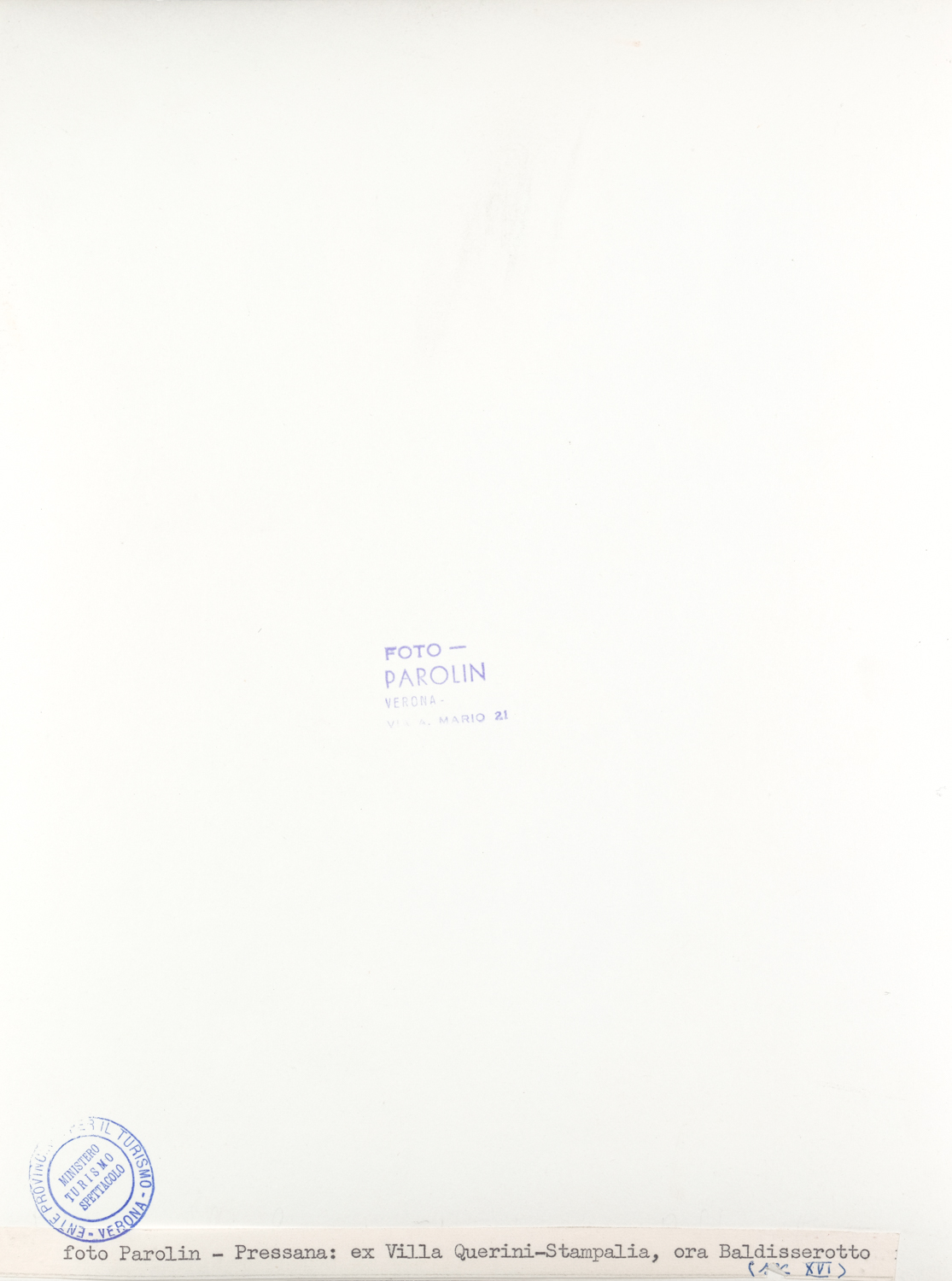
title and artist stamp on verso
Photograph from a collection of tourism photographs from the first half of the 20th century, issued by Italian tourism boards. High-quality works by renowned studios, such as the Alinari brothers, were frequently used to promote Italy as a travel destination. With the West German Economic Miracle (Wirtschaftswunder) of the 1950s, these idealized images of longing became a reality: rising prosperity and increased leisure time transformed vacations into a status symbol. Italy – particularly the Riviera and the Adriatic coast – became the number one destination of choice. By the mid-1950s, 4.5 million Germans were already traveling across the Alps, marking the beginning of modern mass tourism.1
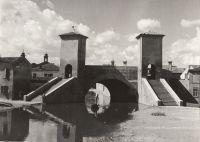
The photograph shows the historic Villa Querini Stampalia in Pressana, also known as “Il Castello.” The villa is one of the first Venetian villas on the mainland and boasts a history spanning millennia, from Roman artifacts and a medieval Benedictine monastery to its transformation into a noble residence by the Querini Stampalia family in the late 15th century. Designed by Giovanni Maria Falconetto, the complex features Ghibelline battlements2, a monumental roof structure, and a chapel adorned with frescoes; it remains in the private ownership of the Baldisserotto family and is open to visitors today.
The photograph captures the moment when Villa Querini Stampalia finally lost its ceremonial function after World War II. It depicts the typical condition of many villas in the Veneto region in the 1950s, before the Istituto Regionale per le Ville Venete (IRVV) was founded in 1958 to legally and financially halt the deterioration of such cultural monuments. The unpaved path, crisscrossed by deep ruts, bears witness to the property’s use solely as a farm during that decade.
(Christoph Fuchs)3
The photograph was taken by Francesco Parolin, a passionate Italian amateur photographer, musician, and collector from Verona, who worked full-time as an employee at the insurance company Cattolica Assicurazioni. In addition to his work, he was an avid pianist, cellist, and ocarina player, and set up his own darkroom in his home on Via Alberto Mario. Through his photographic collaborations with the Touring Club and the Ente Lirico Arena, he maintained close ties with the cultural scene and photographed figures such as the painter Angelo Dall’Oca Bianca, the composer Bruno Maderna, and the tenor Nino Martini. His significant historical photo archive, comprising over 1,000 images – preserved by his son Giuseppe – comprehensively documents the development and profound urban changes in Verona and the surrounding province between 1915 and 1960, including the dramatic destruction of World War II.
(Marco Capelloni)4
Notes
1
"Geteiltes Deutschland: Modernisierung. Bundesrepublik im Wandel. Tourismus", Lebendiges Museum online, Deutsches Historisches Museum, https://www.hdg.de/lemo/kapitel/geteiltes-deutschland-modernisierung/bundesrepublik-im-wandel/tourismus.html (accessed 26.6.2026)
2
Ghibelline battlements (also known as swallowtail battlements) are V-shaped notches cut into a wall. In medieval Italy, they served as a political marker, indicating that the owners were supporters of the Holy Roman Emperor (Ghibellines). The common alternative to these were the square Guelph battlements of the faction loyal to the Pope – cf. Wikipedia (German)
3
cf. "Villa Querini Stampalia detta Castello di Pressana", www.magicoveneto.it (accessed June 25, 2026)
4
Summary of the article: Marco Capelloni, "Mille foto raccontano come siamo cambiati", L’Arena, June 26, 2016, www.larena.it (accessed June 25, 2026)

S-3092, Front view
© Francesco Parolin
S-3092, view verso

© Francesco Parolin

© Francesco Parolin

© Francesco Parolin

© Francesco Parolin

© Francesco Parolin


© Francesco Parolin


© Francesco Parolin


© Francesco Parolin

© Francesco Parolin

© Francesco Parolin

© Francesco Parolin


© Francesco Parolin


© Francesco Parolin
![S-3111, Achille Villani & Figli, "Ravenna. [Sar]cofagi che [la] tradizione [at]tribuiva [a Galla Pla]cidia, mer[avi]glio[samen]te i[ll]uminati. La lune[tta mostra s]una gra[ticola e il] martir[e S. Lorenzo]", 1950s](/y/images/Hauptansichten/S_3111_full.jpg)
© Francesco Parolin

© Francesco Parolin

© Francesco Parolin