


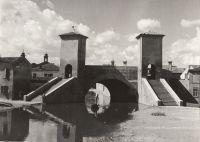


Florence
gelatin silver print
artist stamp on verso
Photograph from a collection of tourism photographs from the first half of the 20th century, issued by Italian tourism boards. High-quality works by renowned studios, such as the Alinari brothers, were frequently used to promote Italy as a travel destination. With the West German Economic Miracle (Wirtschaftswunder) of the 1950s, these idealized images of longing became a reality: rising prosperity and increased leisure time transformed vacations into a status symbol. Italy – particularly the Riviera and the Adriatic coast – became the number one destination of choice. By the mid-1950s, 4.5 million Germans were already traveling across the Alps, marking the beginning of modern mass tourism.1
The view of Florence shows the classic view over the historic Renaissance metropolis from the heights south of the Arno. Captured from the Giardino di Boboli, the view is framed in the foreground by dense trees, directing the eye toward the defining skyline of the old town. Rising from the sea of rooftops are the monumental Cathedral of Santa Maria del Fiore with Brunelleschi's dome, Giotto's freestanding campanile, and the defensive tower of the Palazzo Vecchio. This world-famous vantage point above the city embodies the ideal image of longing for a Tuscan cultural landscape, which has been passed down for generations.
(Christoph Fuchs)
Ivo Bazzechi was an Italian photographer from Tuscany who, after completing his training and spending his first professional years in Florence, founded his own photography studio in the early 1950s. He specialized in the photographic documentation of art, architecture, and museums in Florence and worked closely with museums, art historians, and historic preservation authorities. His work gained particular significance through his extensive documentation of the restoration efforts following the devastating 1966 Florence flood. His photographs, including numerous images of the flood disaster as well as documentation of museum collections, now constitute an important historical visual archive and are preserved at institutions such as the Kunsthistorisches Institut in Florence and the Museo Galileo.
(Summary from Wikipedia)
Note
1
"Geteiltes Deutschland: Modernisierung. Bundesrepublik im Wandel. Tourismus", Lebendiges Museum online, Deutsches Historisches Museum, https://www.hdg.de/lemo/kapitel/geteiltes-deutschland-modernisierung/bundesrepublik-im-wandel/tourismus.html (accessed 26.6.2026)

S-3091, Front view
© Fondo Bazzechi

S-3091, view verso

© Fondo Bazzechi

© Fondo Bazzechi

© Fondo Bazzechi

© Fondo Bazzechi

© Fondo Bazzechi


© Fondo Bazzechi


© Fondo Bazzechi


© Fondo Bazzechi

© Fondo Bazzechi

© Fondo Bazzechi

© Fondo Bazzechi


© Fondo Bazzechi


© Fondo Bazzechi
![S-3111, Achille Villani & Figli, "Ravenna. [Sar]cofagi che [la] tradizione [at]tribuiva [a Galla Pla]cidia, mer[avi]glio[samen]te i[ll]uminati. La lune[tta mostra s]una gra[ticola e il] martir[e S. Lorenzo]", 1950s](/y/images/Hauptansichten/S_3111_full.jpg)
© Fondo Bazzechi

© Fondo Bazzechi

© Fondo Bazzechi