


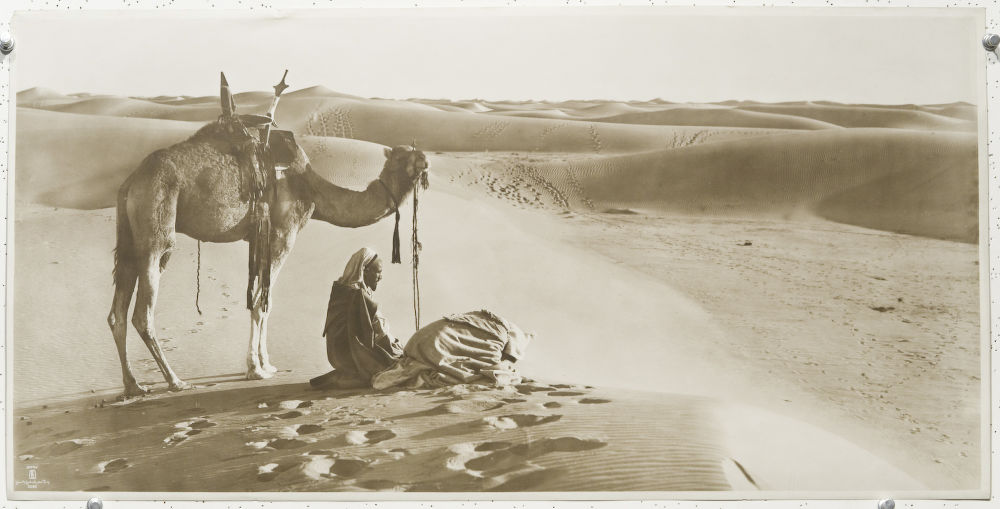
"La prière au désert"
Neg. Nr. 5060
gelatin silber print, hand-colored
artist's sign and title imprinted
Rudolf Lehnert and Ernst Landrock met in Switzerland in 1903. Originally from Bohemia and Saxony respectively, they shared a keen interest in the Orient, a region fantasized about and constructed by the European imagination, relayed in particular through literature, painting, fashion, and photography. In 1904, they opened their first photography studio in Tunis, then under French protectorate. Lehnert took photographs in Tunisia, Algeria, Egypt, and Palestine, while Landrock managed the studio. Their success was largely based on the production of postcards, which were highly prized and widely distributed at the time. The adventure was interrupted in 1914 by the First World War. In 1920, they founded the Orient Kunst Verlag company in Leipzig, then opened a new studio in Cairo in 1924, in a territory under British occupation. After their separation in 1930, Landrock continued the commercial exploitation of these images, first alone, and later together with his heirs. The studio produced thousands of photographs of landscapes and idealized figures, dunes, oases, harems, and odalisques, which forged a stereotypical vision of the Orient. A Lehnert & Landrock bookstore still exists in Cairo, at its original address. In 1985, Ernst Landrock's descendants deposited the studio's archives at Photo Elysée, which is responsible for their conservation.
(Photo Elysée, Lousanne)
The colour picture does not show naturalistic colours (if such a thing exists at all), but the colouring was done from memory and thus shows a subjective idea of colours.
(Fritz Simak)

S-0775, Front view
© Lehnert & Landrock / Edouard Lambelet & Musée de l'Elysée

S-0775, Back view

© Lehnert & Landrock / Edouard Lambelet & Musée de l'Elysée
© Lehnert & Landrock / Edouard Lambelet & Musée de l'Elysée

© Lehnert & Landrock / Edouard Lambelet & Musée de l'Elysée