Nude
(original title Sunbath)
gelatin silver print
embossed signature and embossed studio seal on cardboard verso, label “The Imogen Cunningham Trust,” inscribed and signed by Rondal Partridge
Imogen Cunningham’s earliest nude photographs date from 1910, when she was still under the influence of Pictorialism, a movement that imbued photographs with a painterly, impressionistic aura. These early works were characterized by romanticism and subtle emotionality. With the advent of Modernism, Cunningham turned to a new visual language.
This modernist vision unfolds in the nude photograph Nude (1932). The model’s body is folded into a shell-like pose. Arms and legs are hidden beneath the body, and the composition is dominated by a expanse of bare skin. The nude is neither romanticized nor sexualized, but comes to the fore as a sculptural, abstract object. Light and shadow sculpt the form, while the reduction to lines and planes directs the viewer’s gaze toward the pure aesthetics of the body. Cunningham herself emphasized that she was "interested in the form… not the person"1, thereby deliberately separating the human body from individual identity and examining it as a formal object.
Cunningham was one of the founding members of the f/64 group, whose members – such as Edward Weston and Ansel Adams – were known for precise, clear photographs and an uncompromising clarity of visual language. In this context, the Nude demonstrates her ability not only to document the human figure but also to explore it formally, as an interplay of volume, line, and light.
This work is exemplary of Cunningham’s modernist phase. It abstracts the everyday, transforms the naked body into a sculptural plane, and combines her technical skill with a sensitive, almost poetic view of the human body. In addition to nude studies, Cunningham experimented throughout her life with portraits, botanical motifs, and industrial architecture, thereby influencing generations of photographers through her uncompromising pursuit of clarity, form, and beauty.
(Christoph Fuchs)
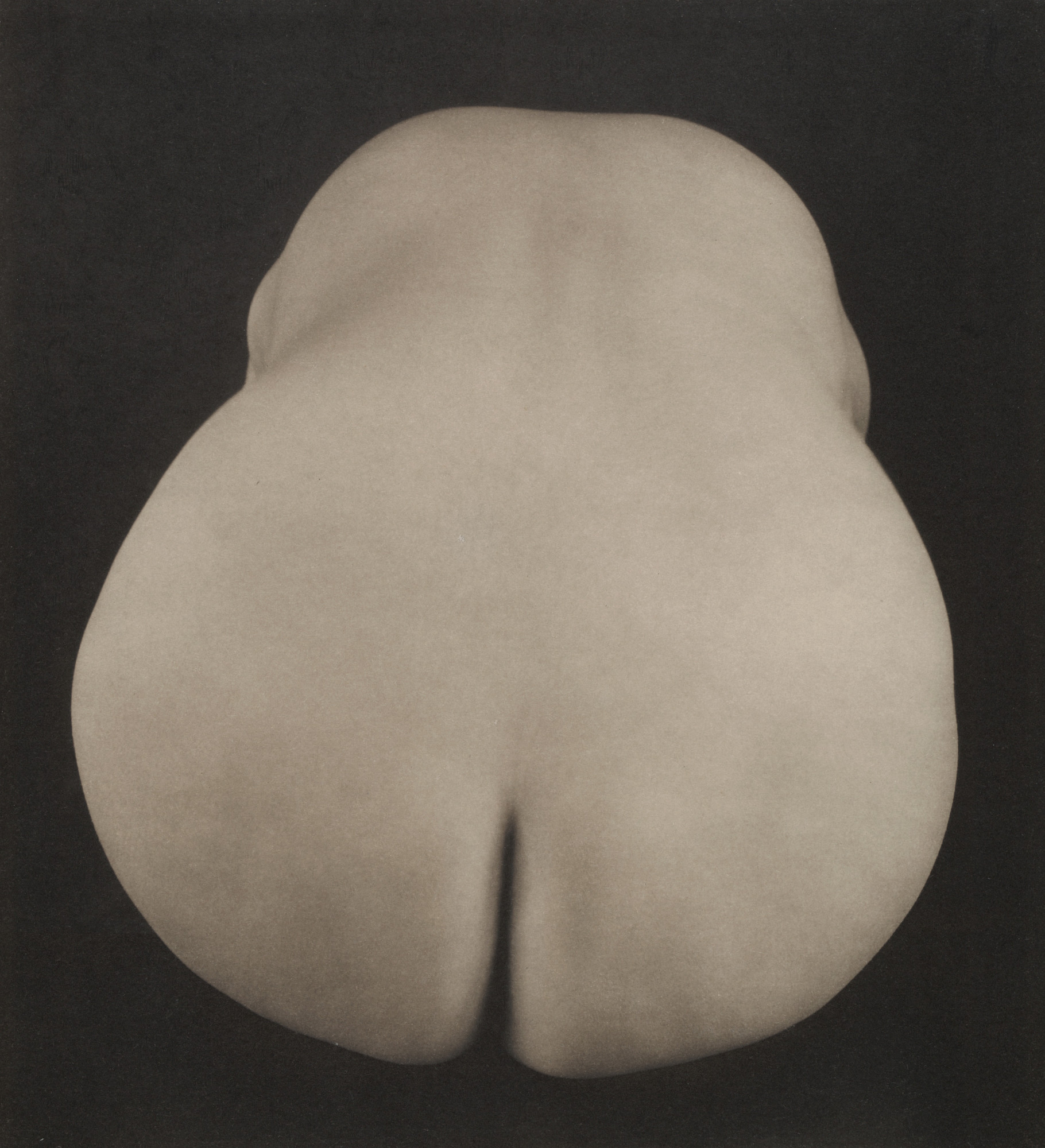
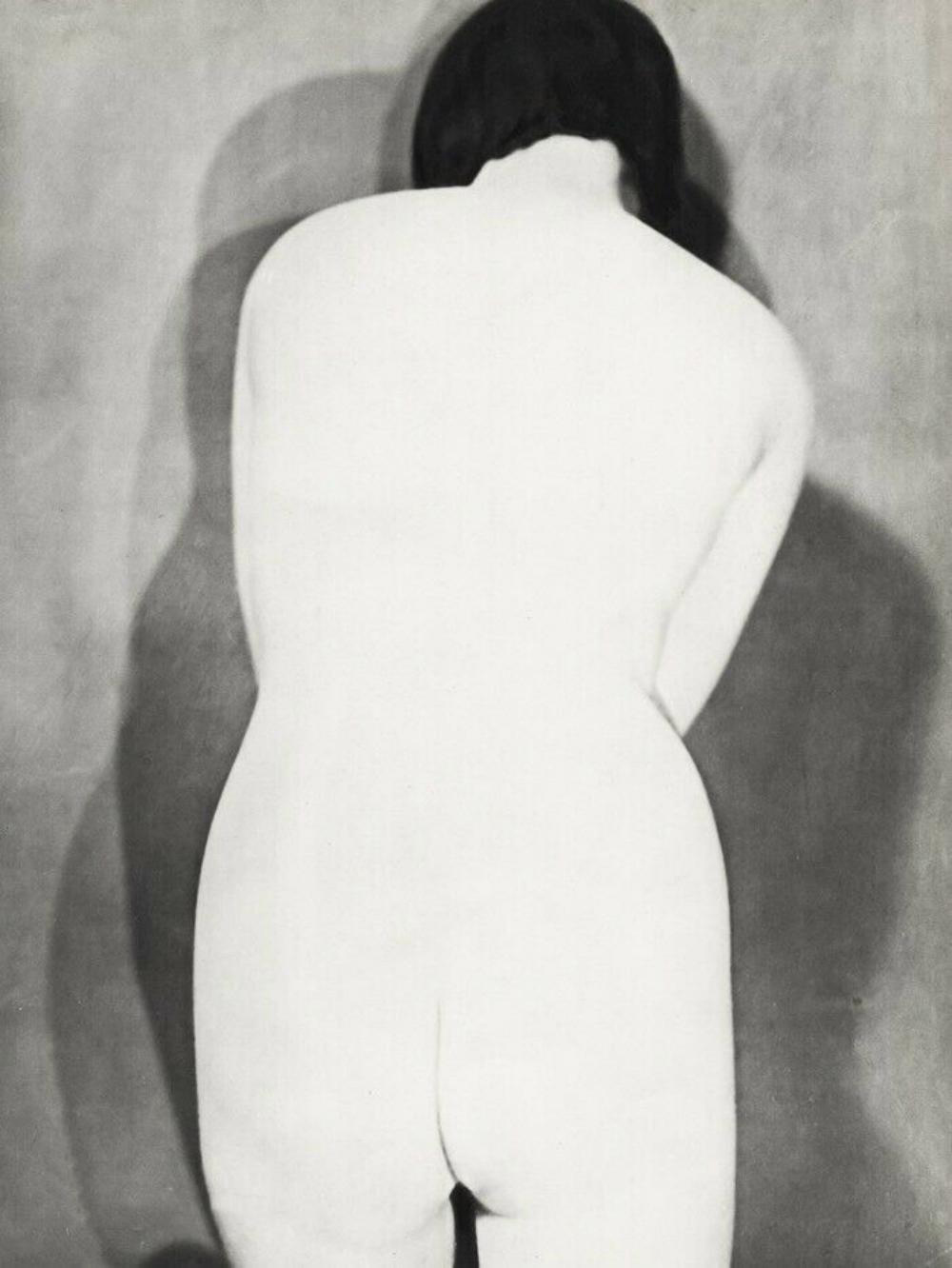
When one considers the potential sensuality of the nude figure, it becomes clear just how objectively and passionately dispassionately Imogen Cunningham and Edward Weston approach the subject. With what sophistication and delight in the new they devote themselves to the abstraction of reality! Anita (also known as Nude, Mexico, 1925) is one of the photographs that marked Weston’s breakthrough. This complete abstraction of light and shadow is possible only through a belief in form – a form that defines the figure and whose volume is barely perceptible due to its foreshortening and the even distribution of light. Weston was ecstatic about his "pear-shaped nudes" and reflected: "Most pictures lack any human emotion on the living, pulsating body. I do not mean to say that this is a better form of photography than conveying realism... yet one must satisfy all needs, and at present I lean toward total abstraction,"2. In his attempt to make form visible, Man Ray casts a similarly impersonal gaze upon a woman’s back in his strangely mad study Dos Blanc (c. 1926). The glaring light on the figure creates a multitude of shadows and turns the back into a flat, white surface crowned by a tuft of black hair. "Photography is not fixed in the role of a copyist," wrote Man Ray. "It is a wonderful discoverer of what our retina never reproduces. … I have tried to capture the things that twilight or too much light, the transience of the object, or the slowness of our visual apparatus conceal."3 With nude (1932, original title Sunbath dated 1931), Cunningham achieves visual effects similar to those of Weston and Man Ray, but the image is less static and far more sensual. From her crouching position, slightly turned and revealing a breast, this lively, elliptical bather seems poised to spring up, in contrast to Weston’s blunt, fruit-shaped figure and Man Ray’s rigid, hourglass-like shell.
(Richard Lorenz, Imogen Cunningham. Körper, Munich 1998, p. 29, translated with DeepL)
Notes
1
Oral history interview with Imogen Cunningham, 9.7.1975, Archives of American Art, Smithsonian Institution, https://www.aaa.si.edu/collections/interviews/oral-history-interview-imogen-cunningham-12850 (accessed 20.3.2026)
2
Nancy Newhall (Hg.), The daybooks of Edward Weston. Volume I. California, New York 1973, S. 136.
3
Man Ray, "Deceiving Appearances", Paris Soir, 23. März 1926, nachgedruckt in Janus (Hrsg.), Man Ray: The Photographic Image, New York 1980, S. 211, zit. nach Richard Lorenz, Imogen Cunningham. Körper, München 1998, S. 29.
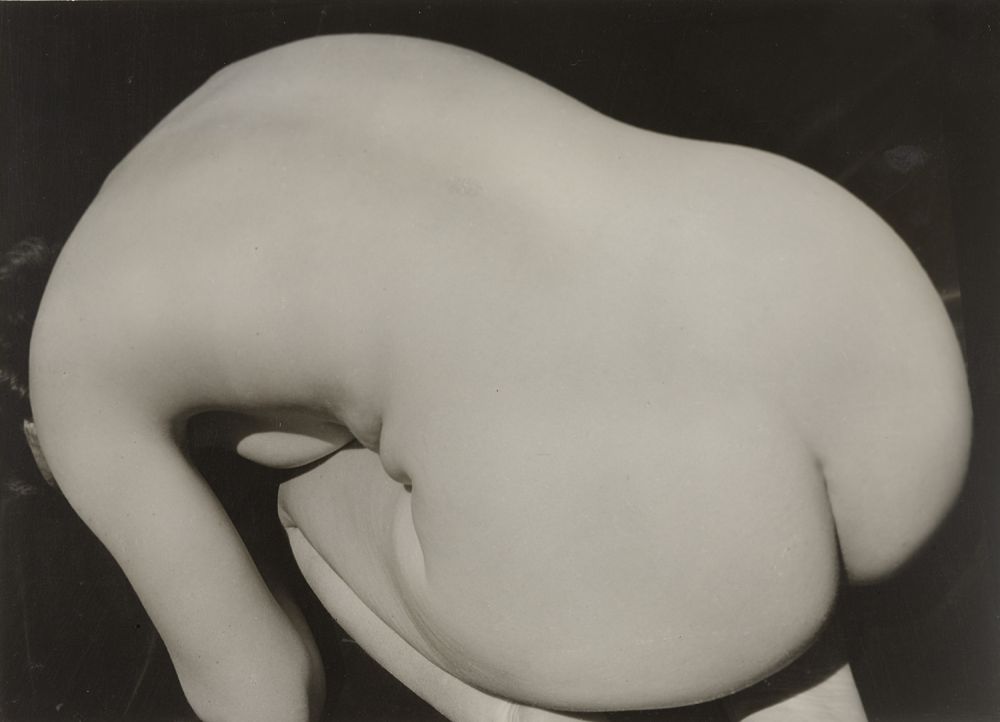
S-2986, Front view
© Estate of Imogen Cunningham
S-2986, cf. Edward Weston, Anita (Nude, Mexico), 1925
S-2986, cf. Man Ray, Dos Blanc, ca 1926