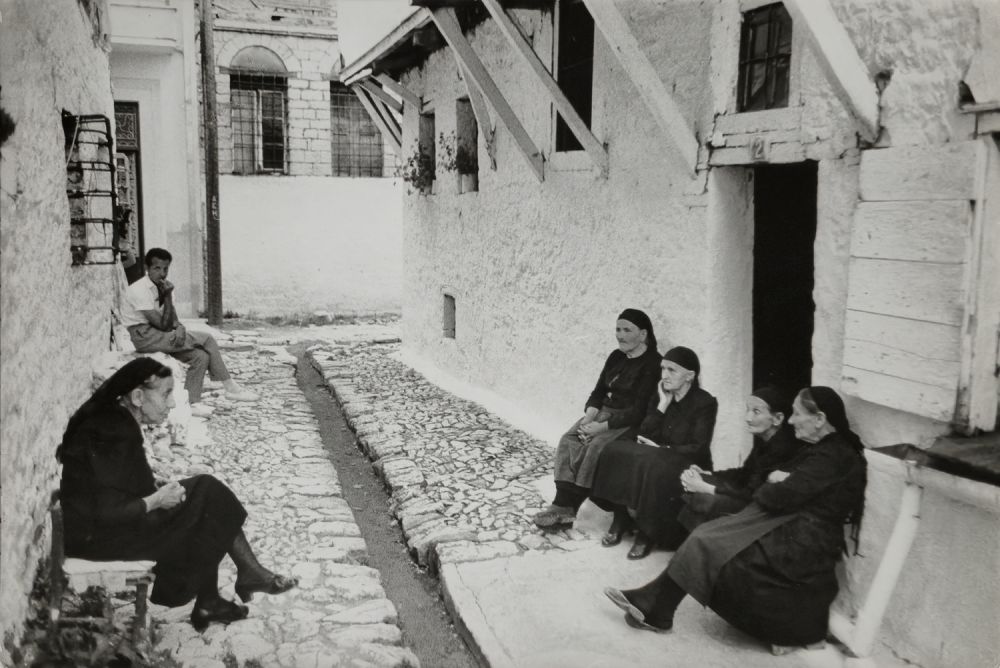
"Town in Ioannina, Epirus Greece"
gelatin silver print
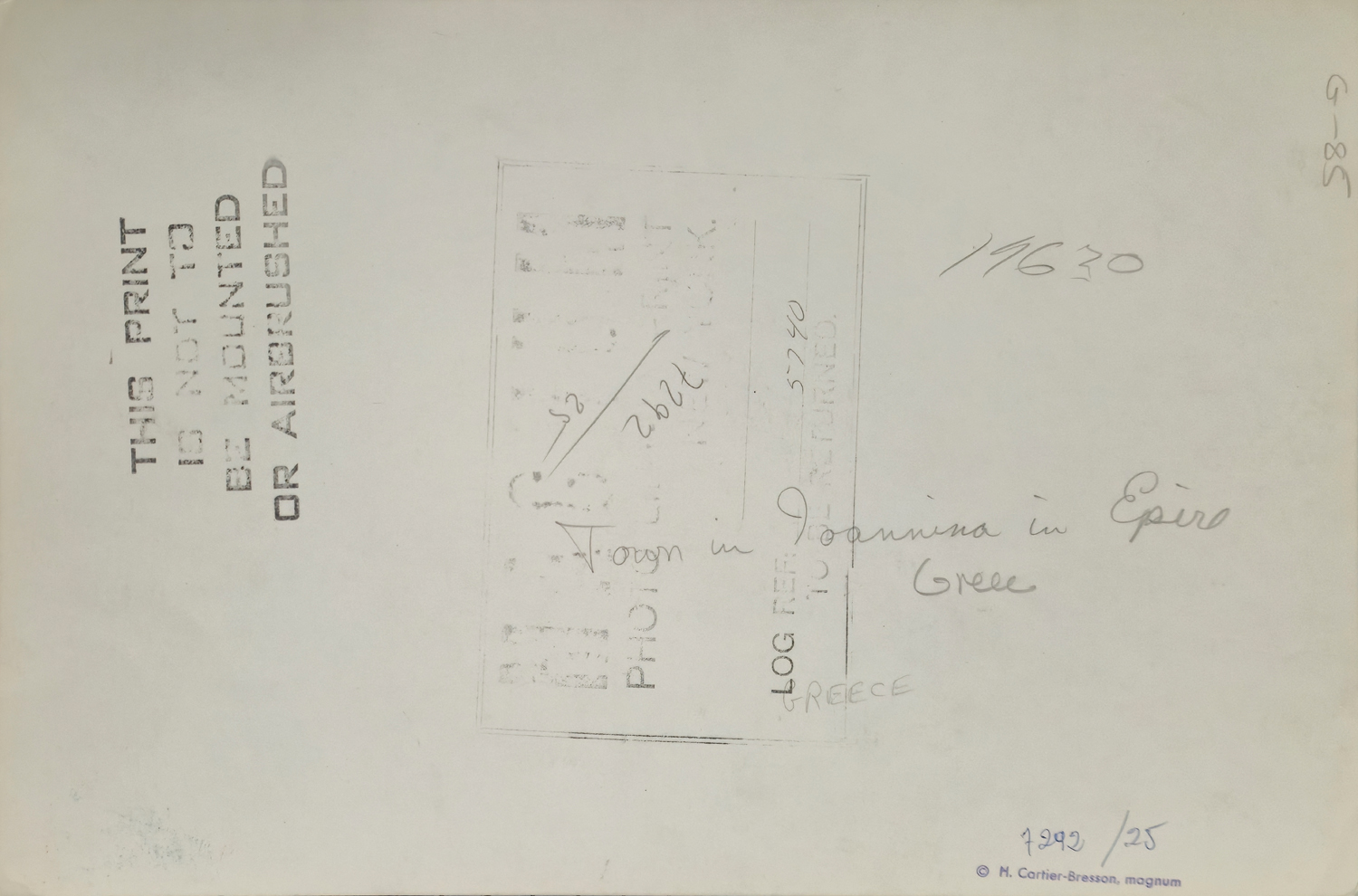
titled (pencil), copyright and artist stamp on verso
I observe. I’m not trying to please people. The only thing that interests me in photography is the immediate aspect. To be there and present: "Bang!" It doesn’t matter what kind of an event it is, because every event is worthwhile in its own right
Henri Cartier-Bresson1
Henri Cartier-Bresson used his philosophy of the decisive moment – named after his famous book Images à la sauvette – to capture fleeting moments that reflect the mood, culture, and characters of the people. Each image tells its own story – from simple street scenes to moments of work, encounters, and movement. His pictures from Greece, including these from Ioannina, are exemplary of his interest in immediate, authentic moments that are not staged. Today, the photographs not only offer a visual insight into Greece in the early 1960s, but also demonstrate Cartier-Bresson's ability to capture time and place in a single image.
Cartier-Bresson traveled to Greece three times in total. The first was a private trip shortly after his marriage to his first wife, the dancer Ratna Mohini, in the summer of 1937 to Athens, Galaxidi, Delphi, Mycenae, Spetses, and Hydra, and contains only two photographs from Megara.
He undertook his second trip in 1953, which differed in one important respect: on Teriand's advice, Yiannis Tsarouchis accompanied him as a guide. This allowed him to get to know an Athens that he would hardly have been able to discover on his own – the strongholds of rebetiko singing, but also important Greeks of the time such as Hadjikyriakos-Ghikas, Elytis, and Spatharis. The three-week trip took him mainly through the Peloponnese – to Corinth, Loutraki, Mycenae, Nafplio, Epidaurus, Sparta, Gythio, Patras, Tripolis, and Areopolis, but also to Arachova, Galaxidi, and Eleusis.
Finally, in 1961, he worked with the Greek National Tourism Organization as an ambassador for Vogue and Holiday magazines, traveling to places such as Meteora, Metsovo, Volos, and islands such as Naxos, Sifnos, and Santorini. In August of the same year, he even extended his stay in Epidaurus to attend the rehearsals and performance of Keroubin's “Medea” with Callas, where the painter signed the stage design and costumes. A rare backstage photo of Maria Callas and Yannis Tsarouchis also originates from there.2(Christoph Fuchs)
Notes
1
Basil & Elise Goulandris Foundation, https://goulandris.gr/en/exhibition/henri-cartier-bresson (accessed 1.3.2026)
2
cf. Lifo, https://www.lifo.gr/culture/photography/oi-agnostes-fotografies-toy-henri-cartier-bresson-apo-tin-ellada-sto-idryma (accessed 1.3.2026)
S-2980, Front view
© Fondation Henri Cartier-Bresson / Magnum Photos
S-2980, view verso