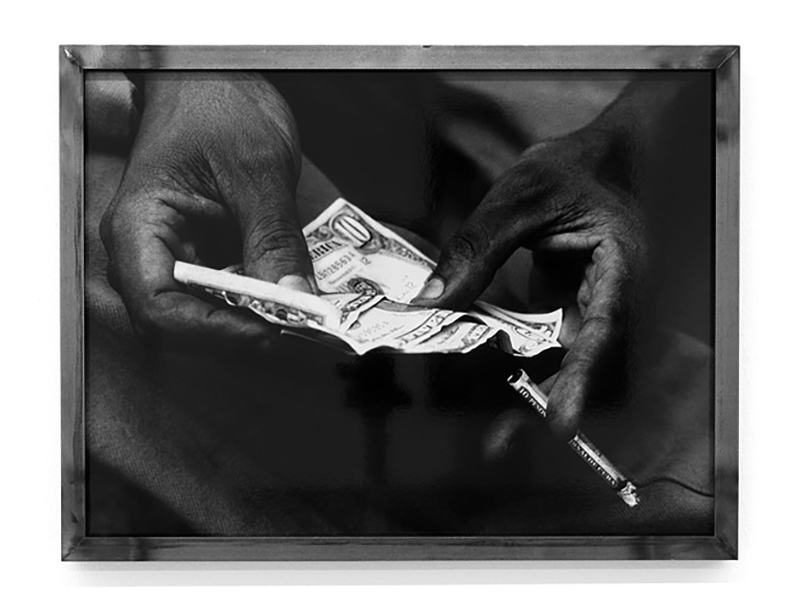
"dineiro cubano"
pigmentbased inkjet print
The work ¡viva fidel! - a journey into absurdity (1997), investigates the aesthetic of possible change in the age of electronic image creation.
Traditional photography and its transformation by digital technologies is one approach with which we can inquire into the ways of perceiving documentary pictures and examine its supposed "authenticity." The project is based on analogue photographic material shot by Michael Najjar during an extentisive journey through Cuba in 1996. Later on the photographic material has been digitally modified. The alterations, however, only become apparent to the viewer on a second look.
At first glance the photos seem straightforward enough in content and appearance. It is the longer look that reveals elements that stand in clear contradiction to the viewer’s knowledge and received perceptions. The work leads to some elementary reflections about documentary photography: The idea of a photo being a genuine image of reality has in fact existed since the beginning of photography. With the rise of the new digital imaging processes the historic indexical relationship between the object and its photgraphic reference is being questioned.
We must not forget that the interpretation of a picture takes place in our heads. The meaning of what we see is never what we see but what it means to us. Pictures are not to concretize reality but to interpret. That is why the question is not about whether or not it is legitimate to manipulate documentary photos – but how.
The series comprises of 12 pictures and takes as its theme the social, economic and cultural status quo of Cuba in the year 1996. Cuba is the last existing socialist tropical paradise, anachronistic, absurd, dadaistic and surrealistic. The system’s only logic is that there is no logic at all. It is a country far removed from any rational comprehension.
As the Cuban painter Vicente Bonachea once said: "The only thing Cubans take seriously is the absurd."
(Michael Najjar)
Following the collapse of the Soviet Union in the early 1990s, Cuba entered what is known as the Período especial (Special Period in peacetime). The loss of Soviet subsidies and oil supplies led to economic collapse. To ensure the survival of the regime and the population, the Cuban government took drastic measures in the mid-1990s. Among other things, it legalized the U.S. dollar as an official currency – the possession of which had previously been strictly prohibited.
In doing so, the regime under Fidel Castro created a dual-currency system consisting of the CUP (Peso Cubano) and the CUC (Peso Convertible). The peso, as the national currency used by the state to pay salaries and to purchase basic foodstuffs via ration cards (Libreta), lost a great deal of its value. At times, the exchange rate stood at over 100 CUP to 1 U.S. dollar. In 1994, the Peso Convertible (CUC) was additionally introduced, pegged 1:1 to the U.S. dollar. In practice, the economy functioned as a proverbial two-tier society: Those who had access to U.S. dollars – through tourism, tips, or remittances from relatives abroad (e.g., Miami) – could buy imported goods, luxury items, and clothing in special dollar stores (Tiendas de Recaudación de Divisas). Those who earned only state pesos lived close to the subsistence level.
The photo shows a person counting U.S. dollar bills. She holds a lit cigarette between her fingers. Only upon closer inspection does the manipulation become apparent: The cigarette paper has been digitally replaced by a rolled-up 10-peso bill from the Banco Nacional de Cuba, which glows at the tip like a cigarette. Michael Najjar is alluding to the worthlessness of the domestic currency. The work illustrates the absurdity of a socialist state in which its own national currency becomes worthless and the monetary system of its declared political arch-enemy, the United States, ensures its economic survival.
(Christoph Fuchs, translated with DeepL)
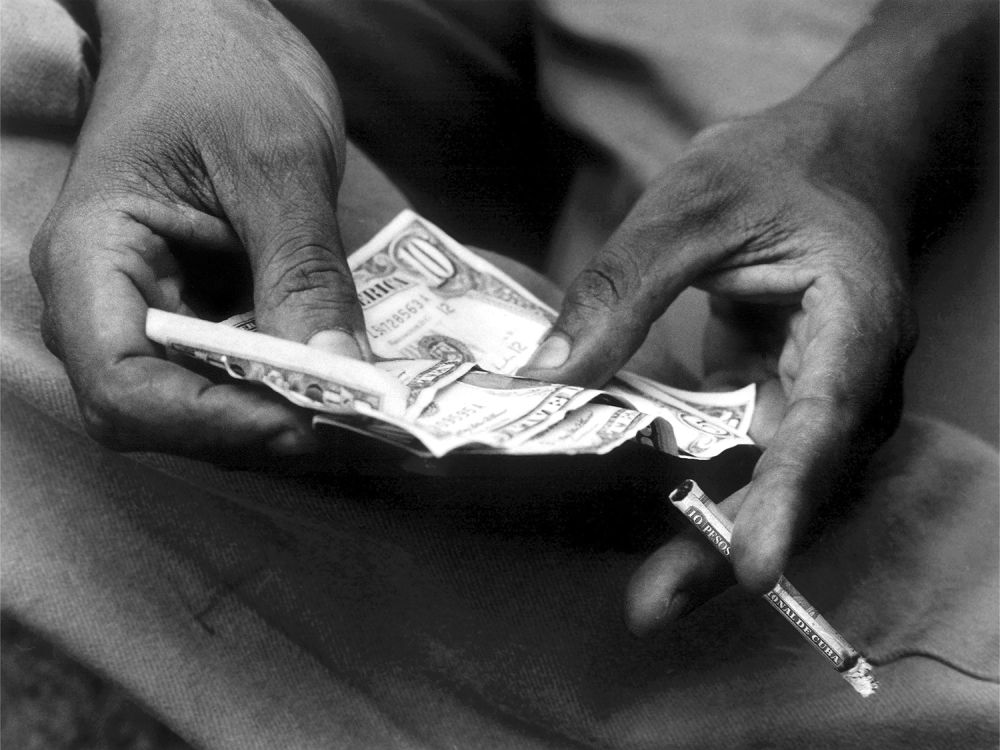
S-3179, Front view
© Michael Najjar
S-3179