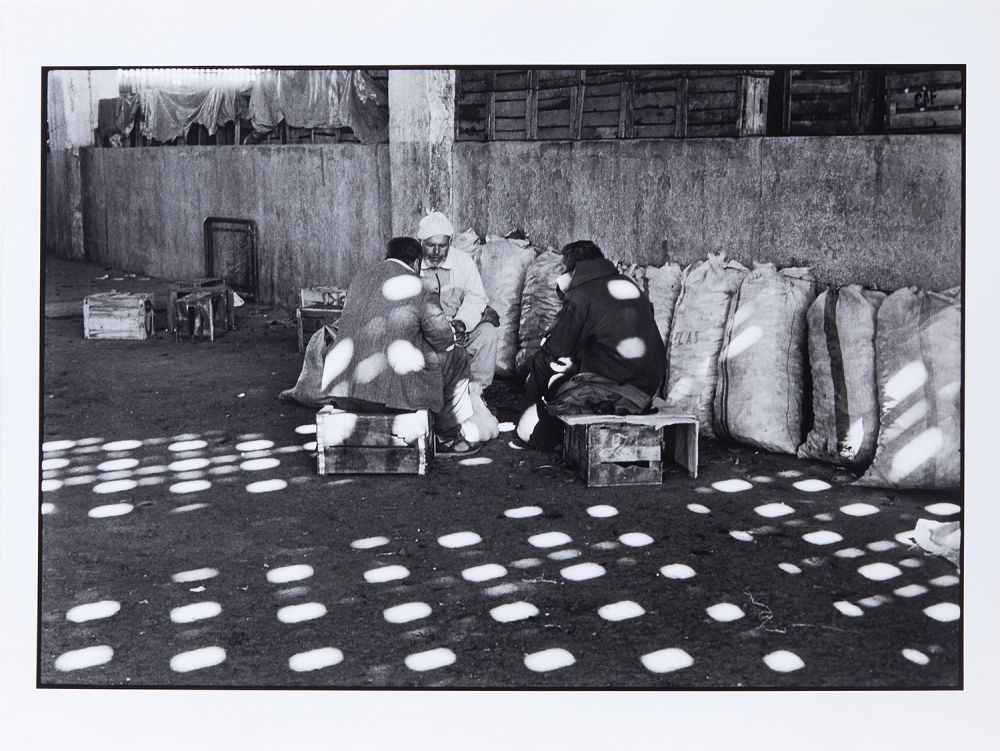
untitled
gelatin silver print
signed (pencil) and photographer's stamp on verso
During a trip to Morocco in 2003, Carlos Freire captured glimpses of the lives of the people he encountered, as well as the landscapes he observed on the plateaus of the Atlas, the Rif, and the Middle Atlas.
Freire emphasizes that his approach in Morocco had no ethnographic, philosophical, or sociological intent whatsoever. “It is these men and women from the valleys and mountains of Morocco who, during my travels, generously and graciously granted me a glimpse into the world of the Berbers.” He documented this period in a book featuring his photographs, accompanied by ten traditional Berber poems and a moving text by Driss Benzekri.
“Amazigh” (plural: Imazighen) is the self-designation of the indigenous population of North Africa, traditionally known as “Berbers.” The word originates from the Berber languages (Tamazight) and translates as “free person” or “noble person.” The foreign term “Berber” derives from the Greek-Latin “barbaros” (barbarian, stranger). For this reason, the indigenous populations of Morocco, Algeria, and other North African countries prefer the self-designation “Amazigh” or “Imazighen.”
(Christoph Fuchs, übersetzt mit DeepL)
S-3124, Front view
© Carlos Freire/Bildrecht, Wien 2026
S-3124, view verso