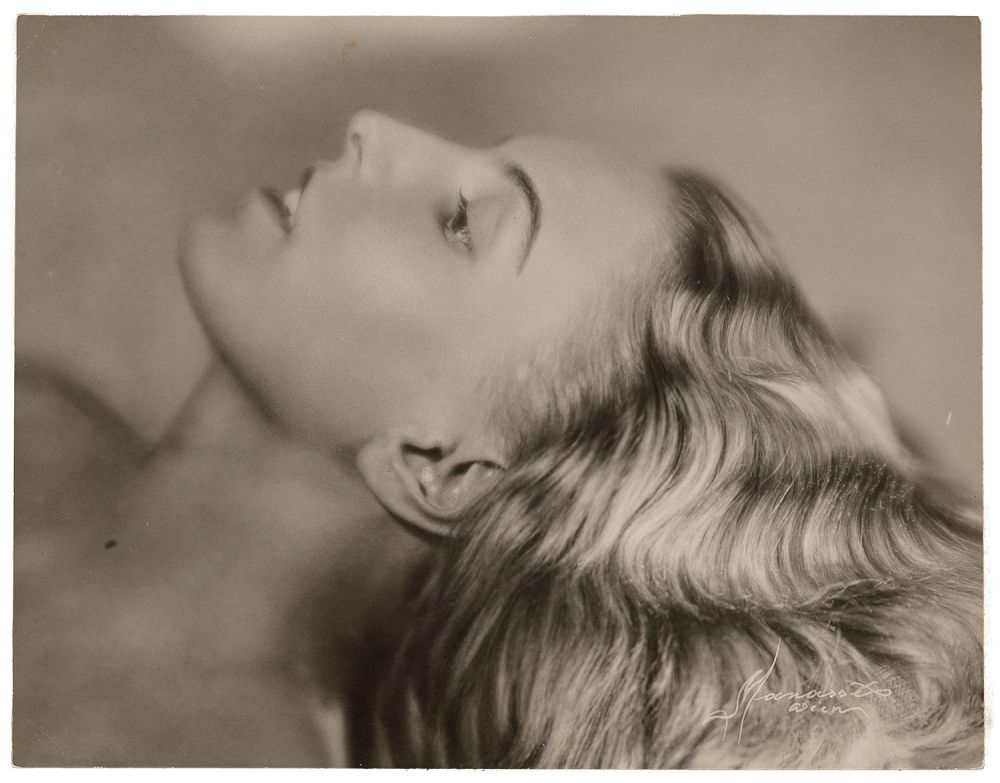
"Dora Seifert, Film"
gelatin silver print
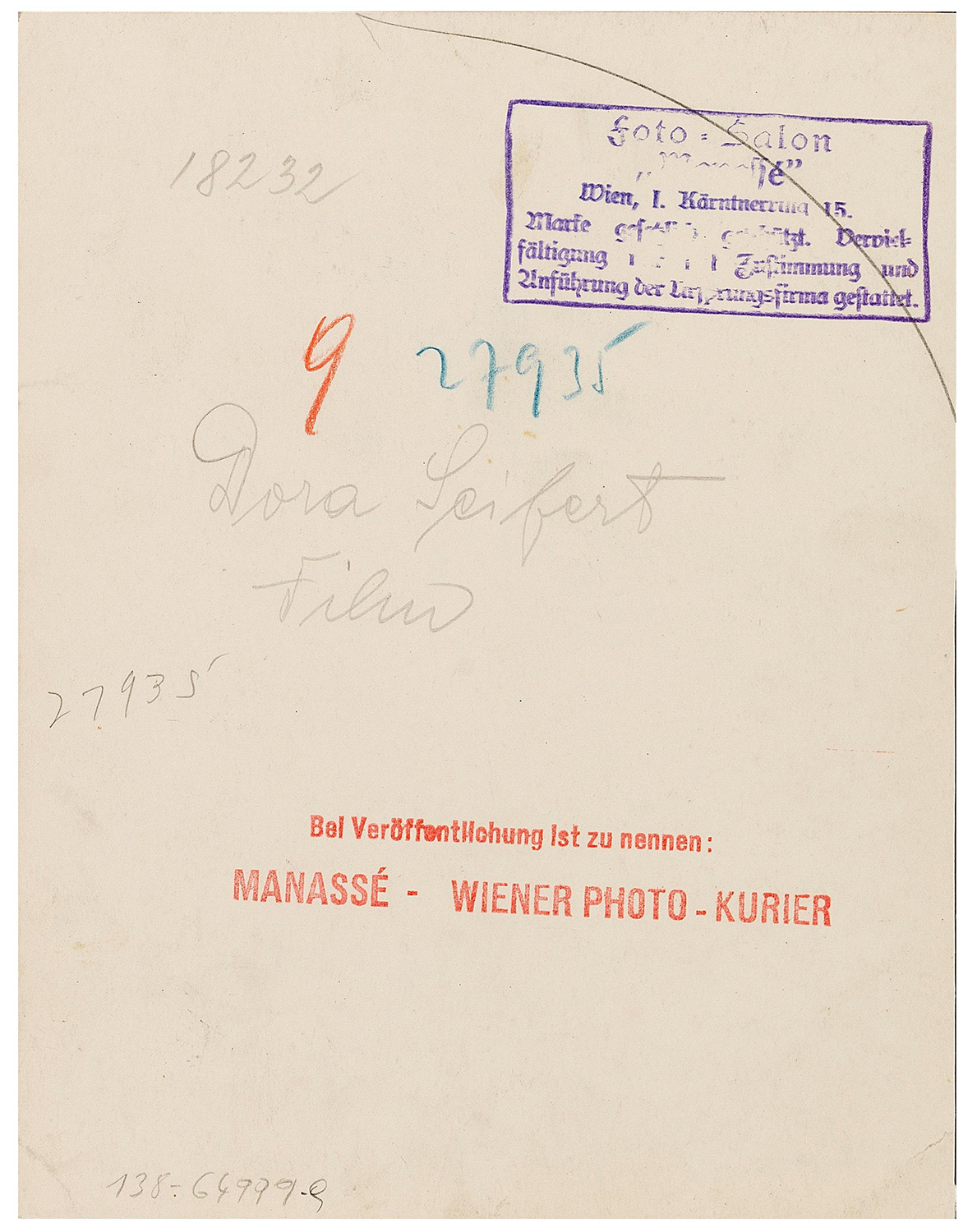
signed on negative, titled (pencil), copyright stamp, “WIENER PHOTO-KURIER” stamp, marked with red and blue colored pencils on verso
The photographs from the Vienna-based Manassé Studio document an aesthetic in which femininity was staged and marketed as a glamorous, eroticized canvas for projection. A prime example of this practice is the 1935 portrait of Dora Seifert.
As was customary for many actresses and film starlets of the interwar period, she had her portrait taken at the renowned Vienna-based Manassé studio. The studio supplied newspapers and magazines (such as the Wiener Photo-Kurier, mentioned on the stamp on the back) with PR and glamour shots for film and fashion coverage.
In this carefully composed photograph, the actress’s body is fragmented and arranged for the audience’s gaze. The extreme framing, which places the face in profile and directs the gaze upward, transforms the subject into a sculptural form. The focus is no longer on Dora Seifert’s individual personality, but on her aestheticized body. This is particularly evident in the styling of her hair, which dominates the pictorial space like a cascading, flowing sculpture. The dense, wavy texture is strongly emphasized by light and shadow and appears almost detached from the person, functioning as an independent visual element. Monika Faber aptly describes such depictions as “corrected bodies”¹, designed for the gaze and shaped according to market expectations. The visual practice of Atelier Manassé thus established an image of women that oscillates between glamorous self-presentation and patriarchal objectification, with eroticism often functioning as stylized availability rather than as an expression of individual autonomy.
(Christoph Fuchs)
Note
1
See Monika Faber, Die Frau, wie du sie willst. Glamour, Kult und korrigierte Körper. Atelier Manassé 1922–1938, Vienna 1998
S-3123, Front view
© Manassé Nachlass
S-3123, verso view