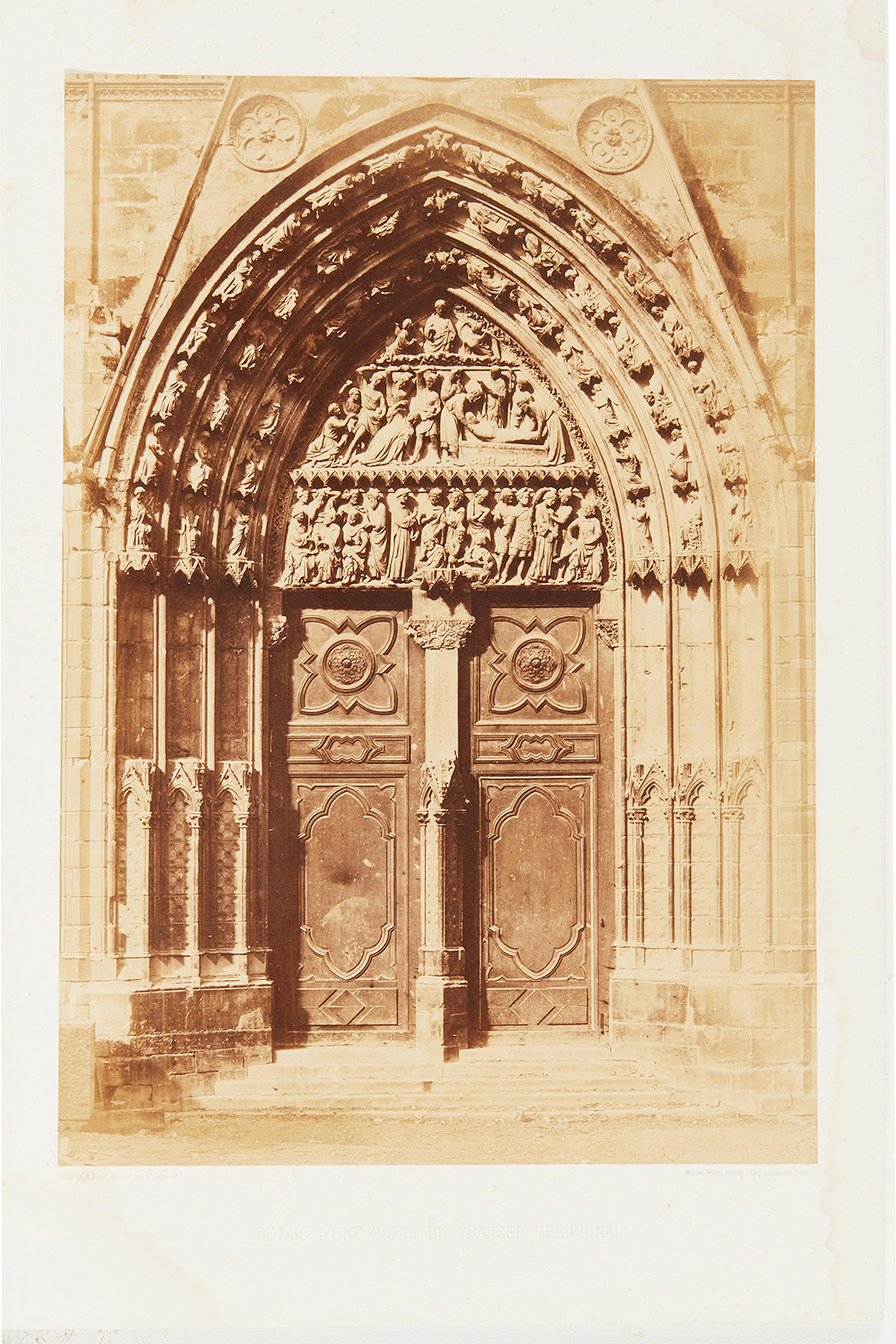
"Detail d'une porte du transep meridional"
Notre Dame, Paris
salt paper on original card board
typographic title, published by A. Morel, Paris, and printed by Lemercier
The photograph “Détail d’une porte du transept méridional” (Detail of a Door in the Southern Transept), taken in 1854, is a striking example of early architectural photography. It depicts the so-called Portail Saint-Étienne on the southern transept of Notre-Dame Cathedral in Paris.
The photograph was taken during a period of monumental upheaval: Beginning in 1844, Notre-Dame was the focus of a comprehensive restoration under the direction of architects Eugène Viollet-le-Duc and Jean-Baptiste Lassus. With their photographs, the Bisson Frères not only documented the condition of this Gothic masterpiece but also created an invaluable visual archive for scholarship, the construction team, and historic preservation. The photograph highlights the three-dimensional depth of the archway above the portal (tympanum), the delicate jamb figures, and the ornately carved archivolts with impeccable sharpness and three-dimensional lighting.
The brothers Louis-Auguste Bisson (1814–1876) and Auguste-Rosalie Bisson (1826–1900) founded their first joint photography studio in Paris in 1841. They quickly rose to become the official and most prestigious photographers of the Second Empire under Napoleon III. Their work was characterized by an unmistakable monumental scope. While many of their contemporaries preferred smaller formats, the Bisson Frères worked with extremely large glass negative plates, which required the highest level of technical precision and craftsmanship. In addition to its Parisian architectural studies, the studio gained international fame through the pioneering work of Auguste-Rosalie Bisson, who, as part of a scientific expedition in 1861, was the first to photographically document the summit regions of Mont Blanc.
The Bisson Frères used the patent-free wet collodion plate process, invented by Frederick Scott Archer in 1851, for their negatives. In this process, a glass plate was coated with liquid collodion mixed with halide salts. In the darkroom, the plate had to be immersed in a silver nitrate bath immediately before exposure, which formed light-sensitive silver iodide. Exposure in the large-format camera and immediate development had to take place while the layer was still wet. Unlike older paper negatives, the smooth glass surface offered previously unmatched optical sharpness and detail.
Back in the studio, a positive print was made on salted paper. To do this, high-quality paper was first soaked in a saline solution and, after drying, coated with silver nitrate. This caused light-sensitive silver chloride to form directly within the paper fibers. The glass negative was exposed directly onto the salted paper via contact printing under sunlight. The print was then processed in a gold tone bath, which gave it its characteristic warm, velvety sepia tone and permanently protected the image from fading.
This photograph exemplifies the combination of the scientific and documentary standards of architectural heritage studies with the artistic aesthetics of the interplay of light and shadow in Gothic stone reliefs. Original prints of this photograph are now held in the most important international collections of photographic history, including the Musée d’Orsay in Paris, the Metropolitan Museum of Art in New York, and the Victoria and Albert Museum in London.
(Christoph Fuchs)
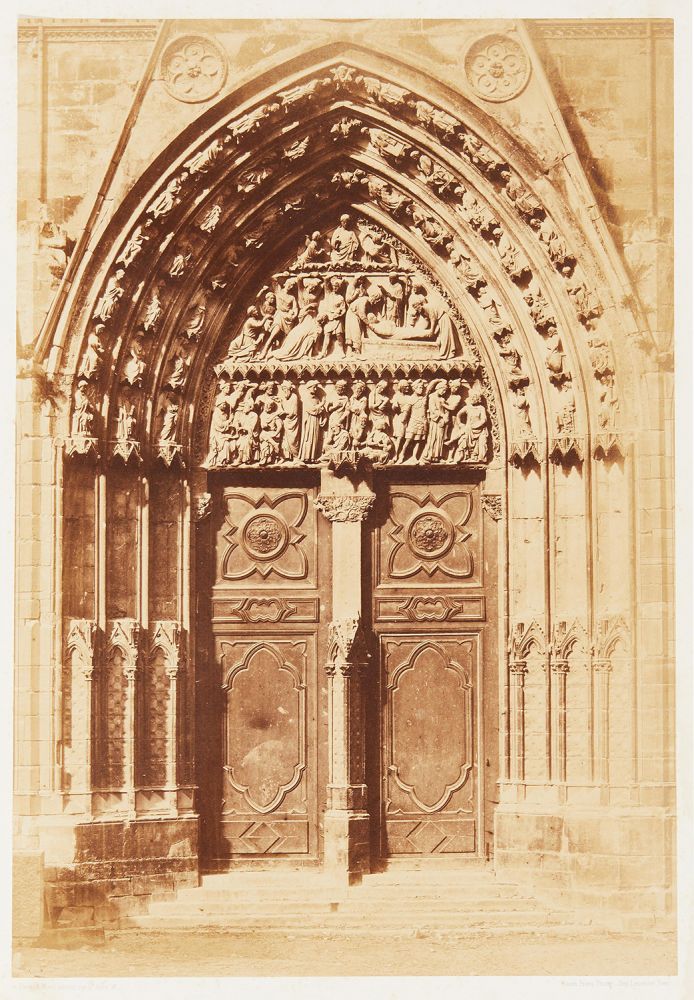
S-3119, Front view
S-3119, total view