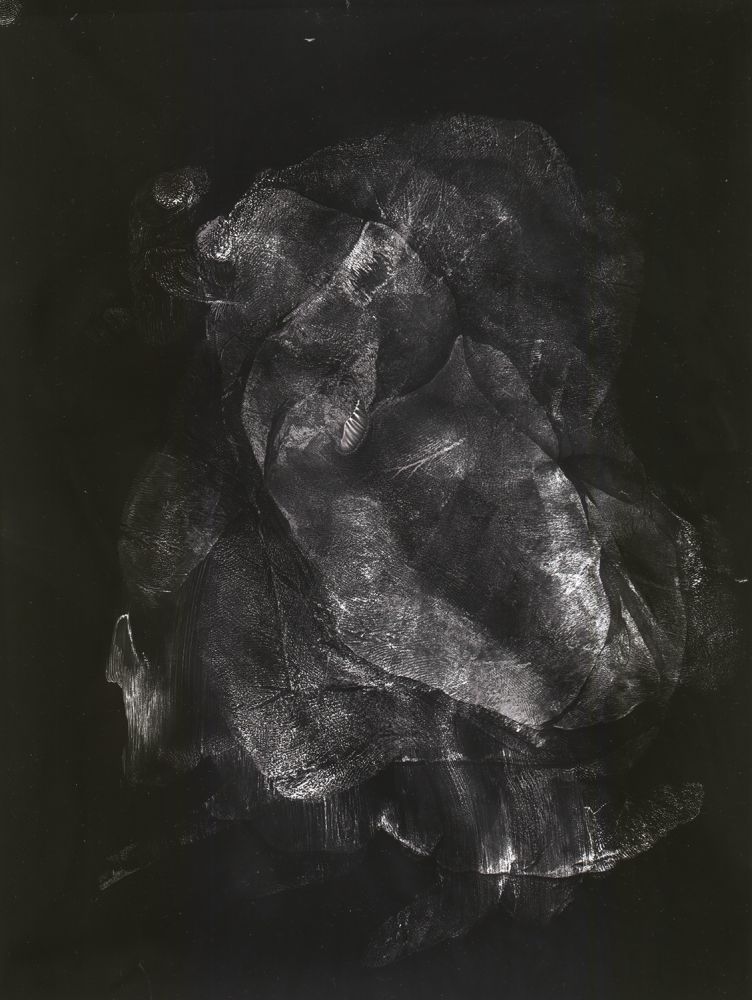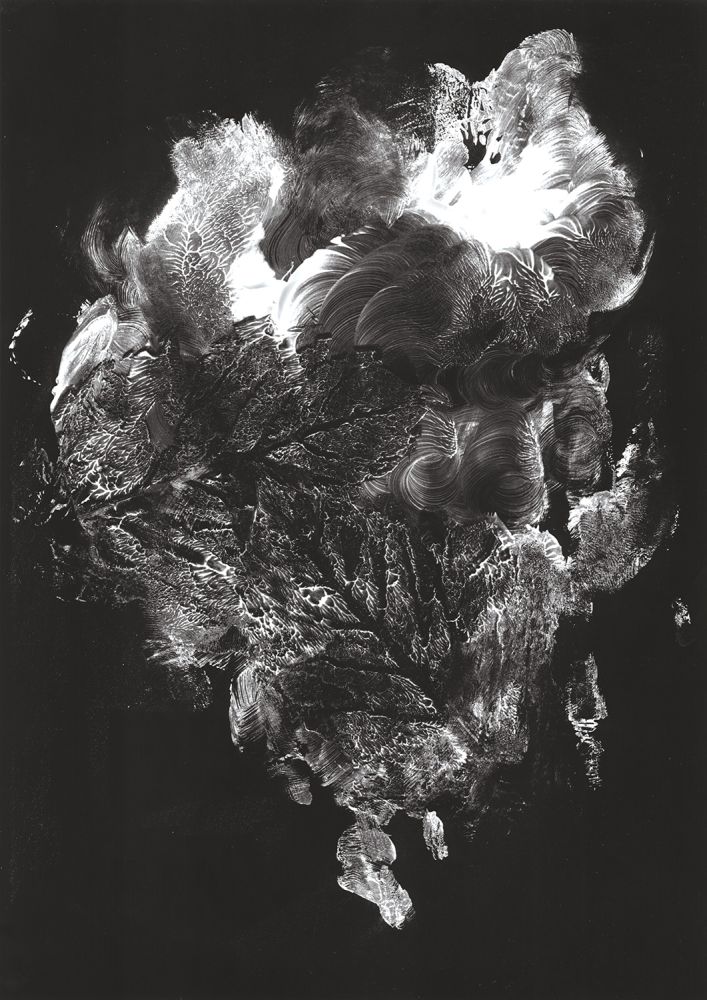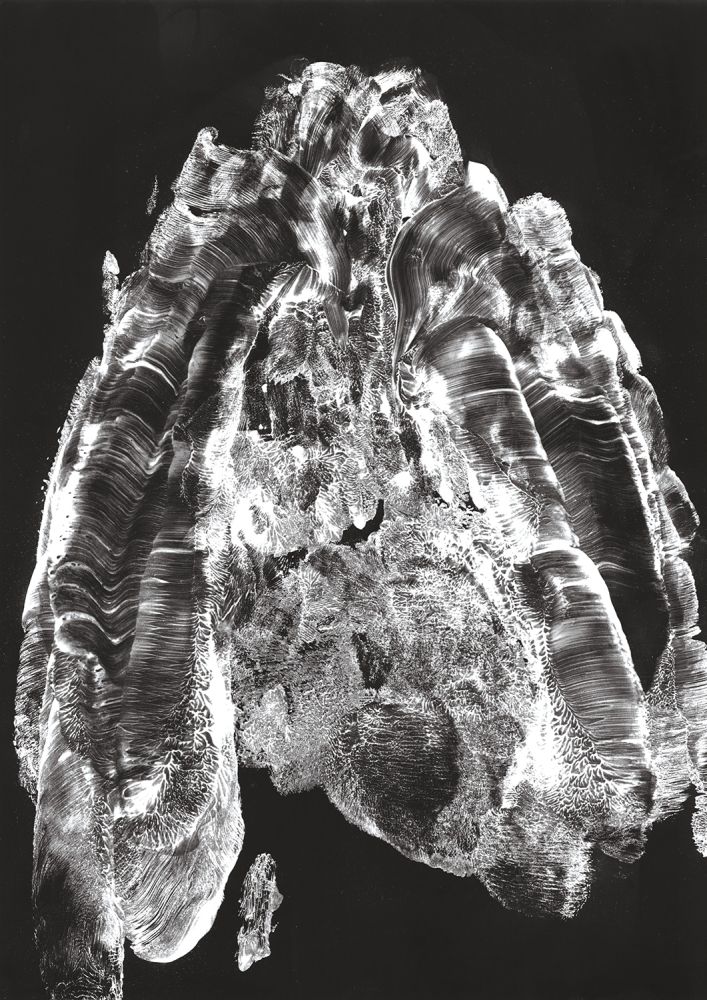
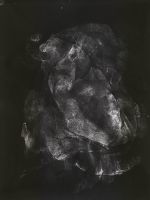
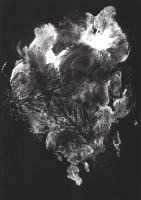
"Printogramm, Nr. 7"
gelatin silver photogram
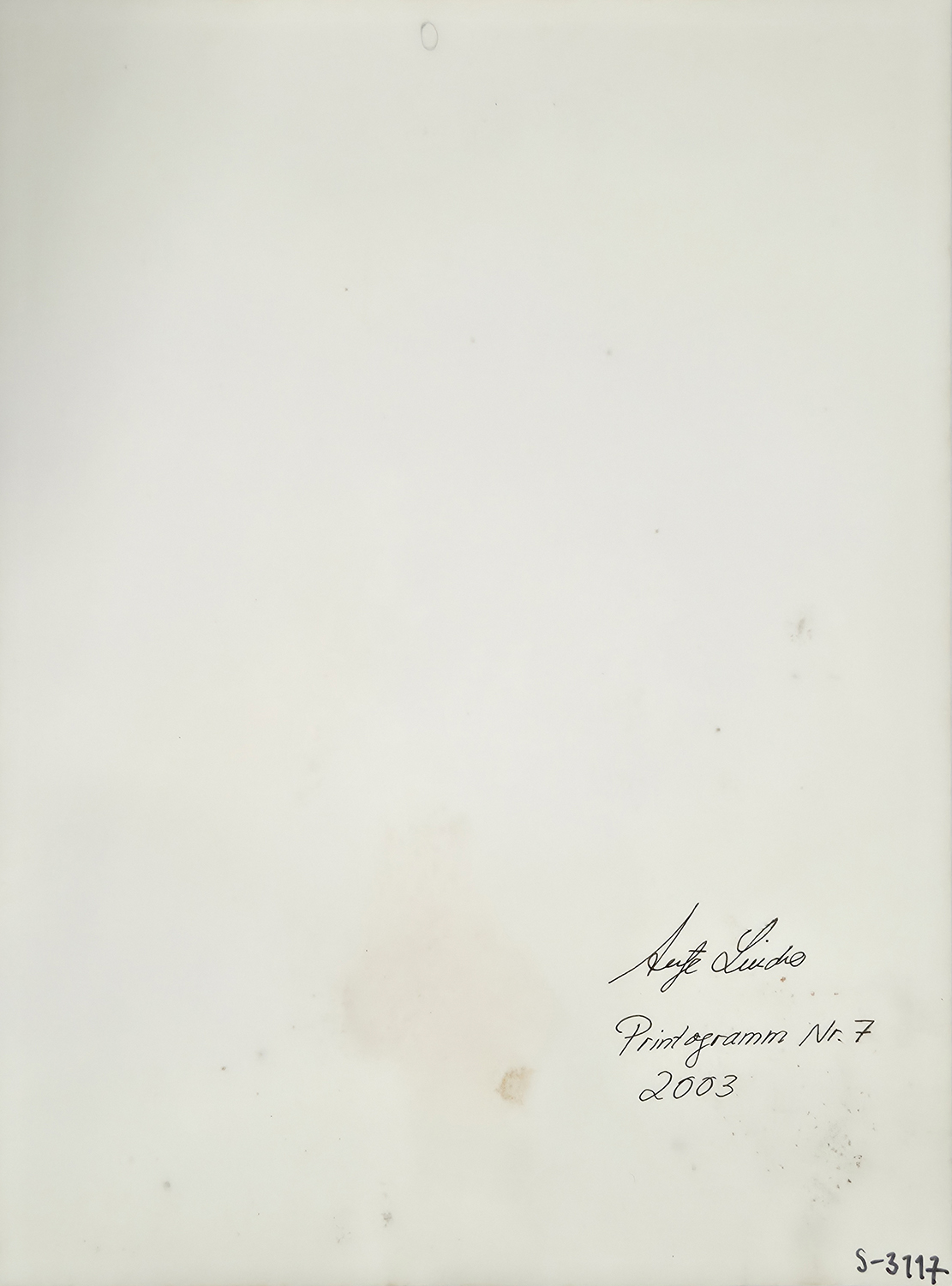
signed, titled, dated (ink) on verso
Since 1999, German artist Antje Lindner has been working on her “printograms” using a cold-exposure technique. In this technique, conventional black-and-white photographic paper is cold-exposed, a method derived from the photogram technique. Through specific chemical processes, her technique makes it possible for imprints and traces—such as those left by the touch of her hands—to become visible on the photographic paper, though only after the development process.
The artist works without the scrutinizing gaze of her own eyes. The printograms emerge at the intersection of the unconscious (according to Sigmund Freud) and chance (according to Harald Lesch). In the darkened room, the artist’s eye cannot control what is happening; the “conscious” cannot determine the outcome of the image, and at the same time, time is frozen. This raises questions about the determinability of the moment—about the power we have over existence. Are we touching upon a collective unconscious here? A collective, shared knowledge? In this almost contemplative creative process, the self can open up to the universal dimension without having to set boundaries. The forms that emerge in the reduced black-and-white palette imply larger, broader contexts, blurring the boundaries between human and nature. The lines and forms left behind by the human cellular structure on the photographic paper transform into abstract, new contexts of meaning—where do these forms come from?
Do they spring from infinite random variations of “everything is possible”? This would echo the philosopher Adorno and his statement, “Where everything is possible, nothing is possible anymore,” for the individual, one-of-a-kind works thus created exude an aesthetic, artistic appeal.
Questions arise, such as whether there are indeed an infinite number of variations, and what “infinity” means in this context; or whether the forms repeat themselves after a certain period of time; whether they are actually the same, or to what degree deviations can be observed. This line of thought allows for a parallel to evolutionary theories, for are there not infinite variations of humanity that are realized in every new child?
Are the photographic results a materialized glimpse of an underlying truth, the interpretation of which lies purely in the eye of the beholder? A value-free primordial landscape, to whose existence every printogram bears witness, in which humanity plays a secondary role—either alongside or within the whole?
What came before us and what will remain after us lingers as an enduring mystery in the mirror of the snapshot within every printogram.
(Antje Lindner, translated with Deepl)