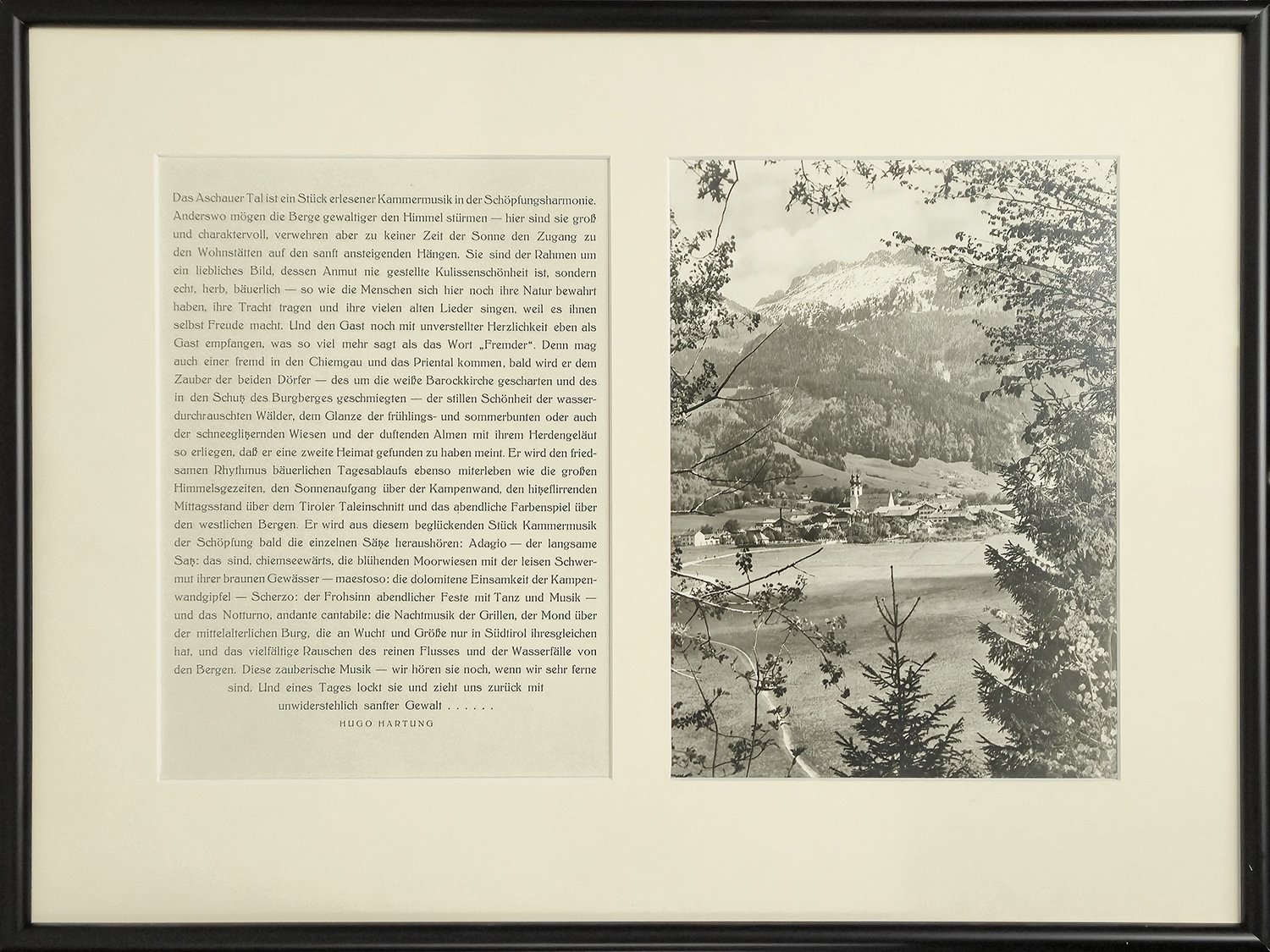
"Aschauer Schlager"
gelatin silber print
The village in the picture features the parish church of Aschau; in the background, the Kampenwand rises as the dominant Alpine feature of the Chiemgau region. Max Baur composes this landscape photograph in a style characteristic of representative postwar pictorial publications. His motif follows a widespread visual vocabulary found in tourist and regional guide depictions: the Chiemgau as an idealized cultural landscape, in which the natural environment and settlement structure merge into a harmonious whole imbued with a sense of local identity.
The combination with Hugo Hartung’s text adds a literary dimension to the visual composition. Hartung was a German writer who was primarily active as a short-story writer and feature columnist and reached a broader audience particularly through his novel Ich denke oft an Piroschka (1954), which was later adapted into a film.
The combination of Baur’s landscape photography and Hartung’s text could serve as a typical example of a high-quality illustrated book or a tourism brochure. The Chiemgau region is less documented here than it is transformed into a culturally charged ideal of landscape.
(Christoph Fuchs, translated with DeepL)
The Aschauer Valley is a piece of exquisite chamber music set to the harmony of creation. Elsewhere, the mountains may tower more majestically toward the sky – here, they are grand and full of character, yet never block the sun’s rays from reaching the homes nestled on the gently sloping hillsides. They frame a lovely picture whose charm is never the beauty of a staged backdrop, but rather genuine, rustic, and rural – just as the people here have preserved their natural way of life, wear their traditional costumes, and sing their many old songs simply because it brings them joy. And they welcome guests with genuine warmth, treating them simply as guests – a gesture that speaks so much more than the word “stranger.” For even if someone comes to the Chiemgau and the Priental as a stranger, they will soon fall under the spell of the two villages – the one clustered around the white Baroque church and the one nestled in the shelter of the castle hill – the quiet beauty of the forests through which water rushes, the splendor of the meadows in their spring and summer colors or glistening with snow, and the fragrant alpine pastures with the ringing of their cowbells – so completely that they feel they have found a second home. He will experience the peaceful rhythm of daily rural life as well as the great celestial cycles: the sunrise over the Kampenwand, the heat-shimmering midday sun over the Tyrolean valley, and the evening play of colors over the western mountains. He will soon be able to distinguish the individual movements in this exhilarating piece of chamber music of creation: Adagio – the slow movement: toward Lake Chiemsee, the blooming moor meadows with the quiet melancholy of their brown waters – maestoso: the Dolomite solitude of the Kampenwand peaks – Scherzo: the joy of evening festivities with dancing and music – and the Notturno, andante cantabile: the night music of the crickets, the moon over the medieval castle, which is unmatched in grandeur and scale anywhere but in South Tyrol, and the varied murmur of the clear river and the waterfalls cascading from the mountains. This enchanting music – we can still hear it, even when we are far away. And one day, it beckons and draws us back with an irresistibly gentle force.
(Hugo Hartung)
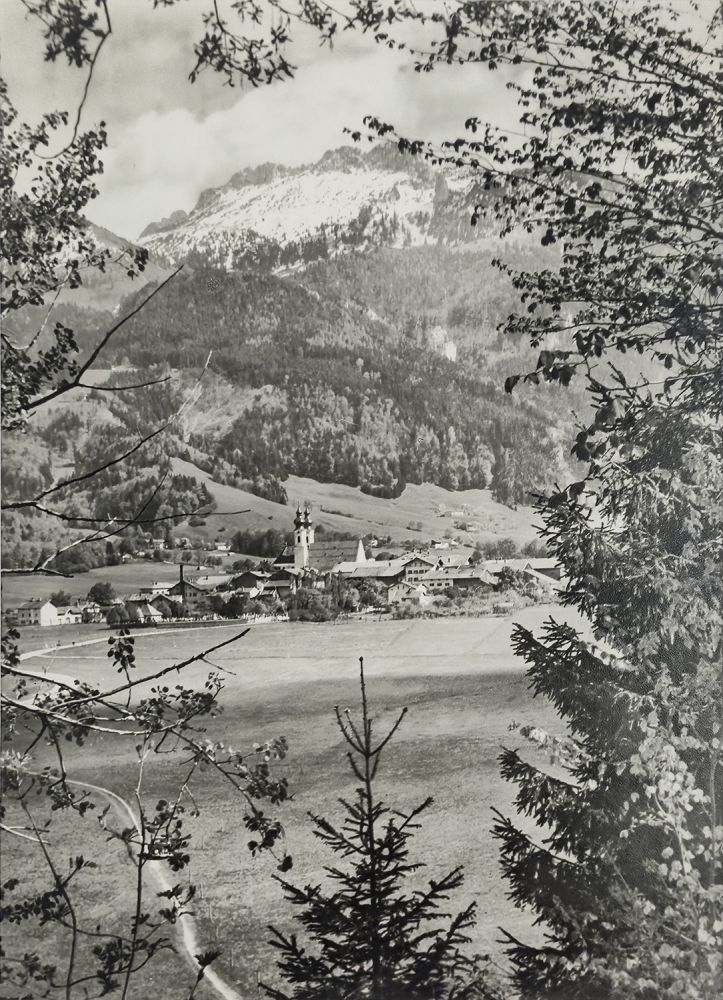
S-3083, Front view
© Lichtbild-Archiv Max Baur
S-3083