"Jubiläumswarte 6"
Robert Zahornicky walks into a forest in winter, sets up a tripod, and turns his panoramic camera to face straight up.
Once the triggers ist action, the lens pans until it has scanned an angle of 140 degree. On the film, this process produces an image measuring 24 by 60 mm.
The views the photographer captures are unlike what he saw when he lookes around himself. The cold eye oft he apparatus commands a different scope of view and perceives things on a different way than man’s visual organs. For instance, it registers the smallest detail even along the edges oft he selection; our vision, by contrast, gets blurrier the more intently we focus on a single spot. More importantly, photography deceives us concerning the nature of things and the impression they create, letting us discern them only os silhouettes. The treetops leaning toward the center oft he picture may look tot he beholder like a sheltering cupola rising above him. Yet as we gaze at the center of one of these images, we also feel a strong pull in another direction, making us fall, as it were, into the sky.
(Timm Starl, 2012 translated by Peter Lillie)
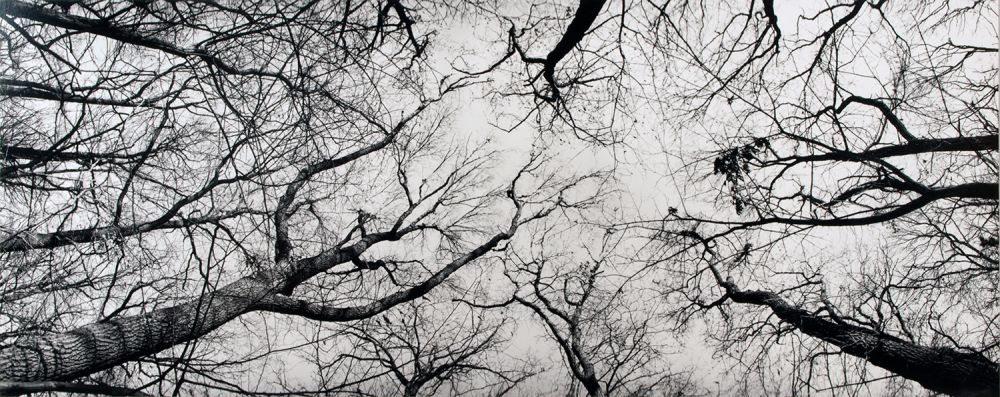
S-3081, Front view
© Robert Zahornicky / Bildrecht Wien