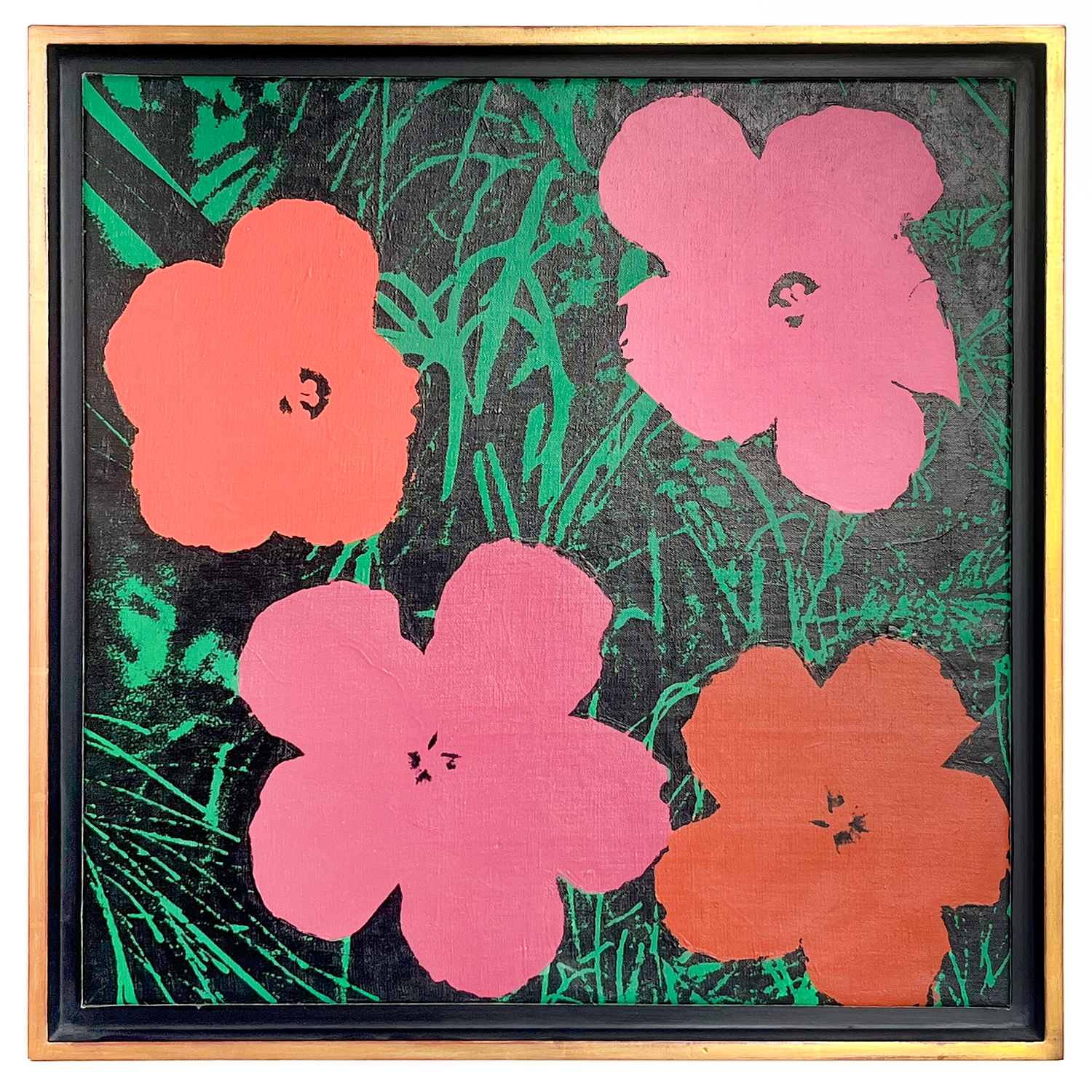
"Warhol Flowers"
silkscreen print and acrylic on canvas
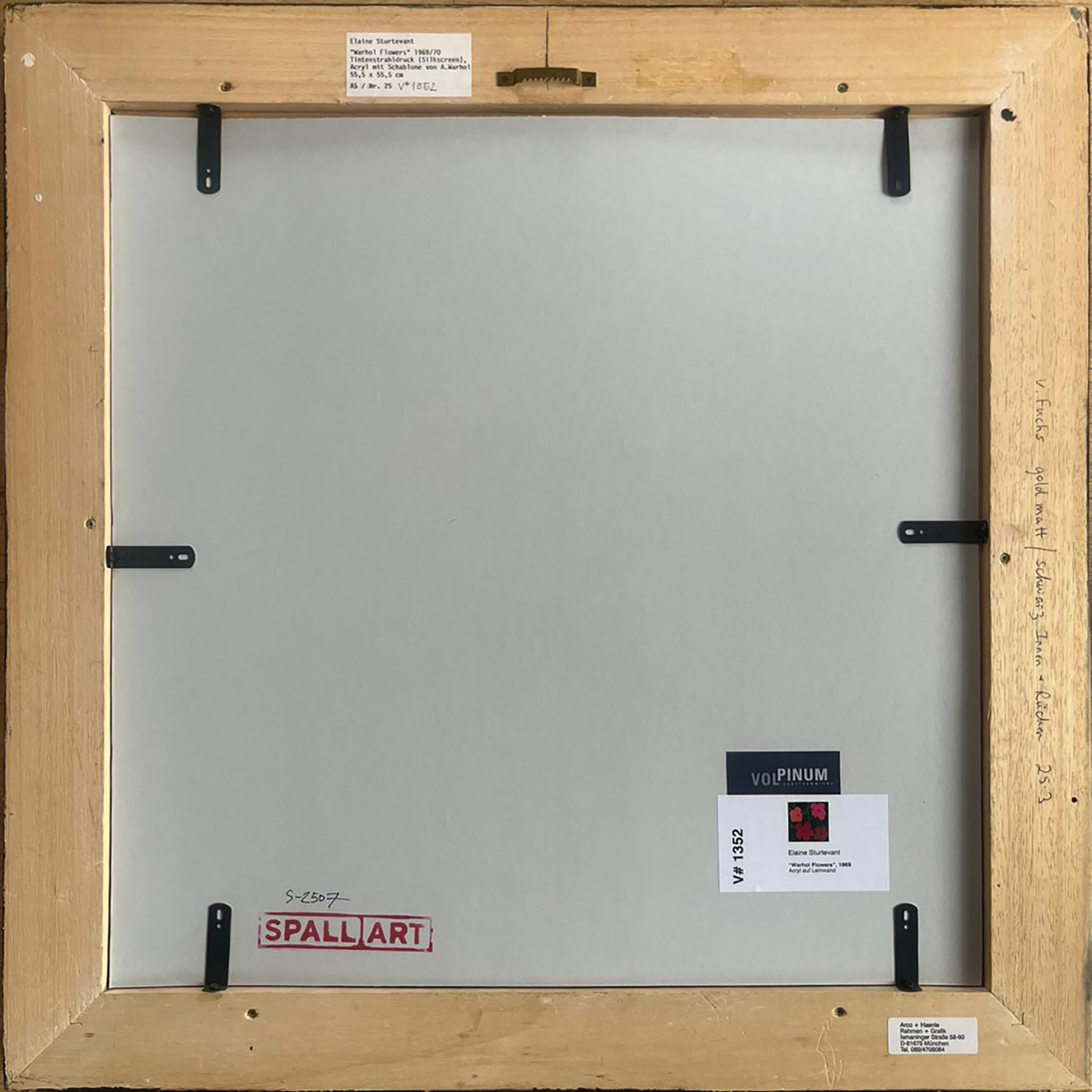
titled, dated, signed on verso verso “Warhol Flowers, Sturtevant 1969/70, Paris”
"I don’t know. Ask Elaine"
Andy Warhol
Executed in 1969-1970, Warhol Flowers belongs to one of Elaine Sturtevant’s most significant and highly celebrated bodies of works. With its vibrant and elegant burst of quintessentially springtime yellow flowers taken directly from Andy Warhol’s iconic composition, Sturtevant thought provokingly builds on the legacy of her male counterparts. Her explorations of appropriation began in 1964, when she started to manually reproduce works of art by memory – focusing at first on those created by her contemporaries including Roy Lichtenstein, Claes Oldenburg, Jasper Johns and indeed Andy Warhol. Selecting easily recognisable motifs from their long established oeuvres and deliberately mimicking their aesthetics, she posed a critical challenge to notions of authenticity and authorship in an era increasingly dominated by reproduction. Furthermore, the importance of Warhol’s ‘brand’ in solidifying Sturtevant’s early career was not only evident through her decision to explore several of his images in her works (ranging from the Flowers to the Marilyns) but also in her choice to present an entire show consisting of her repetition of Warhol’s Flowers in 1991, some twenty six years after Warhol’s historic exhibition of his original flower paintings at New York’s Leo Castelli Gallery.
While engaging in strategies of appropriation, Sturtevant notably goes beyond merely questioning the discourse of original and copy. Merely a year after the debut of Warhol’s Flowers at Castelli Gallery, Sturtevant lined the walls of Bianchini Gallery with her own tongue-in-cheek Warhol reproductions – here juxtaposed with a white sculpture resembling a work by George Segal shown pulling a garment rack laden with paintings evocative of works by the likes of Jasper Johns, Arman, Claes Oldenburg and Frank Stella. In doing so, Sturtevant effectively exposed the political, economic and cultural circumstances that underpins art’s creation, circulation and consumption under a male dominated canon.
As in the present work, Sturtevant used a silkscreen that Warhol had given her to create her own version of Warhol’s composition. Famously, when asked about his own technique, Warhol was reported to have said, "I don’t know. Ask Elaine"1. With this in mind, paintings such as Warhol Flowers at first glance appear as perfect copies, however Sturtevant’s creative output is best understood as studies that expose broader systems of value within the art world. Indeed art historian Peter Eley has argued, "By faking, [Sturtevant] showed that she was not a copyist, plagiarist, parodist, forger, or imitator, but was rather a kind of actionist, who adopted style as her medium in order to investigate aspects of art’s making, circulation, consumption, and canonization"2. Since her passing in 2014, Sturtevant has received the critical attention she was denied for much of the late 20th century. After receiving the Golden Lion Lifetime Achievement award at the 2011 Venice Biennale, her work was celebrated in her first comprehensive survey in the United States since 1973 beginning at The Museum of Modern Art, New York in 2014.
(Sotheby's)3
Notes
1
Andy Warhol quoted in: "Elaine Sturtevant, Who Borrowed Others’ Work Artfully, Is Dead at 89," New York Times, May 16, 2014, https://www.nytimes.com/2014/05/17/arts/design/elaine-sturtevant-appropriation-artist-is-dead-at-89.html (accessed May 20, 2026)
2
(Peter Eley, quoted in Exh. Cat., New York, The Museum of Modern Art, Sturtevant: Double Trouble, November 2014 – February 2015, p. 50)
3
original article Sotheby's, https://www.sothebys.com/en/buy/auction/2023/women-artists/warhol-flowers (accessed May 20, 2026)

+S-2507, Front view
© Elaine Sturtevant Estate, Paris
+S-2507
+S-2507