untitled
photo: Josef Neuhauser
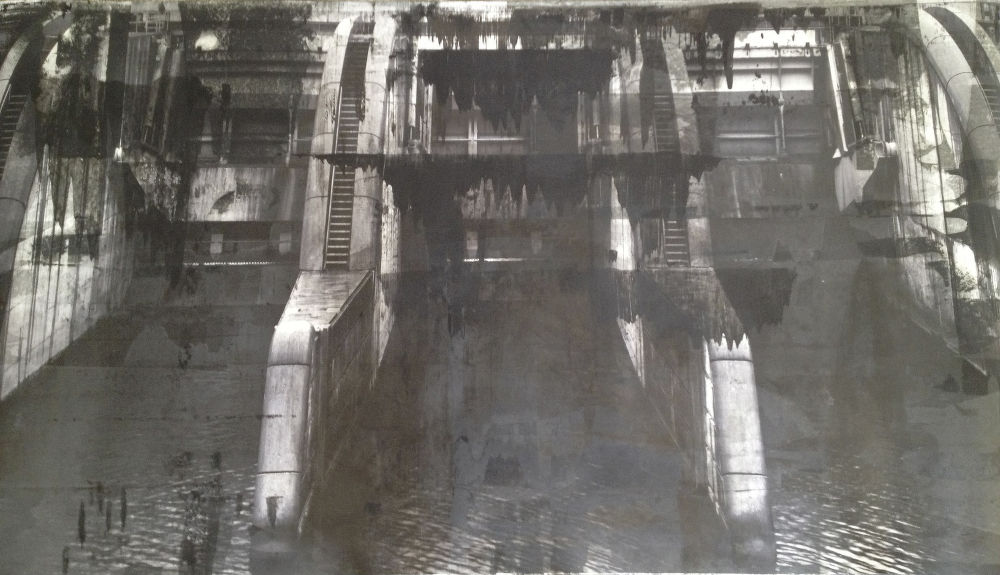
Acrylic, oil on latex ink on Verona cotton paper 250g
signed and dated on verso
As a painter, Erwin Bohatsch very quickly embarked on a path that led out of the tradition of the "New Painting" of the 1980s. His conceptual-analytical approach within abstract painting made him one of the most radical representatives within this medium in this country. While in his most recent paintings it was mainly border areas of painting that were evoked by extreme reduction of painterly means, it is now photography that is integrated into the artistic process.
Inspired by the photographs of the collector and photographer Josef Neuhauser, experiments were created that investigate the relationship between the two media. These are not aimed at the motif search of painting within technical images, as has been the case for some time in connection with media-reflexive painting. Rather, the painter here reacts directly to the photographic image.
The large-format black-and-white photographs become the painting surface on which Bohatsch applies the colour substance (usually black). The abstract painter accepts at that moment a given pictorial structure, which he does not further work on in terms of narrative readability, but rather starts out from formal considerations. The two media are thereby extinguished as far as possible in their respective existence or are transformed into a new picture reality. Just as Bohatsch's unprimed canvas is often used as a colour accent and thus plays an essential role in the design, here he uses the photograph with its black and white structures as a quasi active painting ground. Similar to Bohatsch's paintings, the painterly parts often appear casual and give the impression of a by-product. A working process with stencils seems to underlie here, which has left traces of paintings that no longer exist. The colour substance, which can certainly be associated with the chemical liquids of photography on the light-sensitive photographic paper, creates another integrative process that brings the two media together.
It is the respective cultural context of the two media that allows the viewer to recognize both photography and painting. In this contemplation, both media become one's own memory.
The realization that behind or under each picture there is already a different picture before it has largely determined representational painting in recent decades. Applied to abstract painting, one must recognize - at least following the eye of the beholder - that there is a fundamental desire to find something readable in the abstract. In Bohatsch's overpainted photographs, the readable elements remain recognizable to the extent that they support precisely this process. Only at second glance do cloud formations, landscapes or architectural elements become recognizable in these pictures. They are remnants of an earlier reality that has been rendered invalid, as it were.
Two media, each claiming prominence in relation to the image in general, are here united in a symbiosis that opens up new possibilities for the other. Bohatsch's procedure on the painting surface - whether on the canvas or, as here, on already existing paintings - does not follow any emotional gestures, but is rather an exact formal calculation. This procedure is in any case conceptual, but at the same time highly sensual.(Bernsteiner Art Space, Vienna, 2013)
S-1515, Front view
© Erwin Bohatsch