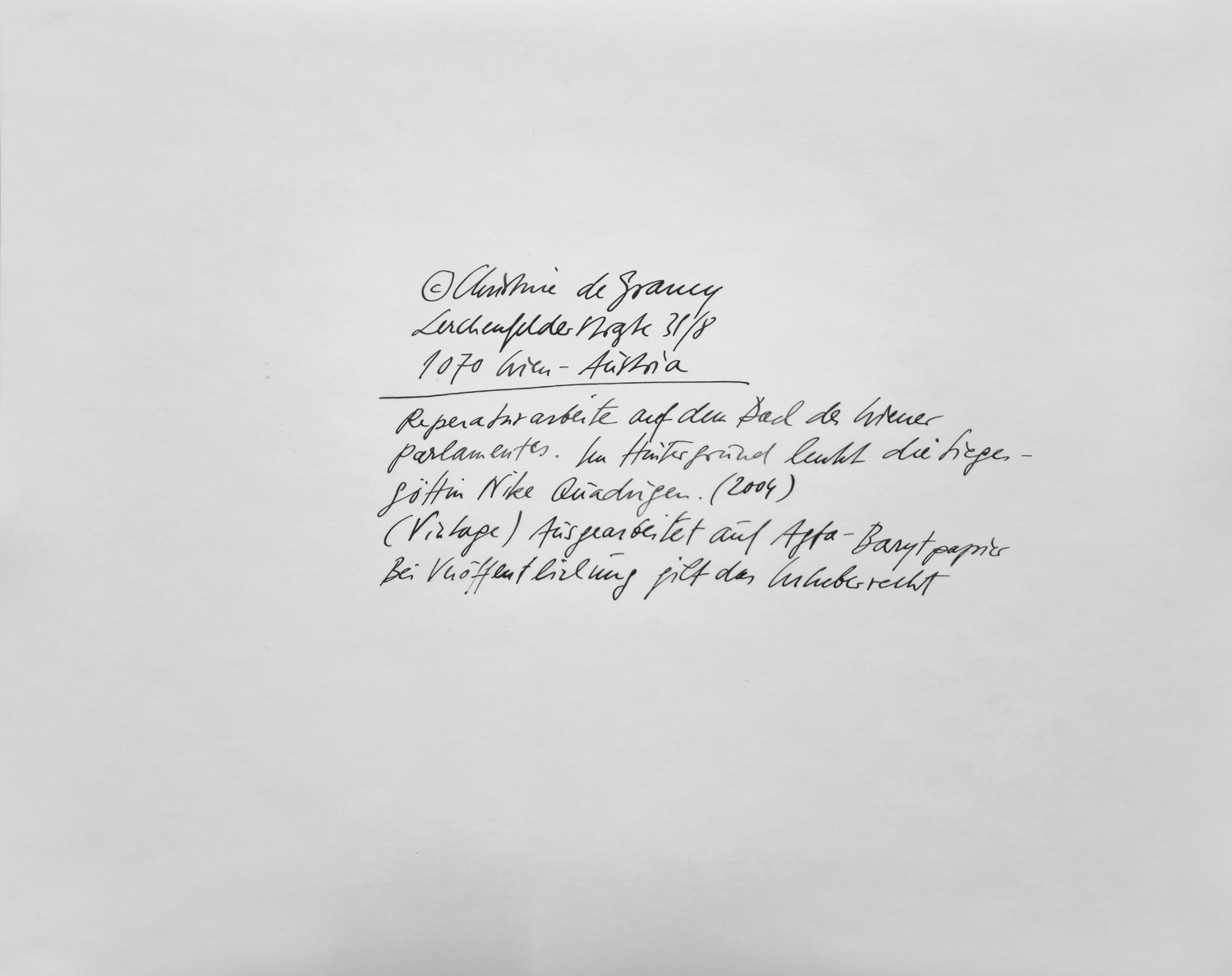
"Reperaturarbeiten auf dem Dach des Wiener Parlaments. Im Hintergrund lenkt die Siegesgöttin Nike Quadrigen"
gelatin silver print on baryta
signed (ink) on recto, titled and dated (ink) on verso
Austrian photographer Christine de Grancy achieved fame primarily through her many years of work as a stage photographer at the Burgtheater. She also took numerous photographs in Tunisia, Tibet, Niger, and Western Sahara. In addition to her work for magazines such as Stern and Vogue, she also published several books.
De Grancy was also known for her photographs of Vienna, which were captured in the book Über der Welt und den Zeiten (Above the World and Time), published in 2021. Her “images of gods” captured the city's numerous statues, which she tracked down on “excursions to Habsburg Disney Land,” as Mercedes Echerer recounts from a conversation with the photographer. De Grancy also had a close connection to the universal artist André Heller, with whom she published several books. At an exhibition opening at Vienna's WestLicht several years ago, he praised her “un-Austrian curiosity about the world.”1
Nike, the goddess of victory, steers her quadriga over the roof of the Vienna Parliament. In the background are the dome of the Michaler Trakt of the Hofburg, the towers of St. Michael's Church, and St. Stephen's Cathedral. The sculpture group was created by Vinzenz Pilz, the favorite sculptor of Theophil von Hansen (1813–1891), the architect of the Parliament building. The originally planned gilding of the carriage was never carried out. The quadrigas with Nike are a symbolic image of the victory of parliamentary democracy over old constraints.
High above the attics of the two hall buildings, the quadrigas rise freely toward the sky, four on the mansion and four on the House of Representatives, corresponding to the horse tamers on the ascending ramp. These horse teams, designed by Hansen as symbols of victory, are intended to symbolize the triumph of parliamentary activities. The quadrigas were cast in bronze based on a design by the sculptor Pilz. The first quadriga was installed in August 1883. The installation of the remaining quadrigas was completed in 1885. They are all identical, the only difference being the attributes of Nike, the goddess of victory. She holds either an olive branch or a laurel wreath in her hands. Nike stands in a single-axle carriage with a low, semicircular body, the front of which is decorated with a double-headed eagle and the Habsburg crown. The goddess is dressed in a chiton, which seems to flutter strongly in the wind and reveals the contours of her body. This, together with the posture of her upper body, which leans forward stormily, gives the quadrigas a great sense of dynamism. This impression is reinforced by the powerful design of the horses.2
Theophil Hansen considered the Parliament building to be his life's work. In addition to designing the building, he also conceived the entire interior, right down to the furniture, with the aim of achieving a harmonious coordination of even the smallest details. Hansen incorporated numerous allusions and references to living democracy into his masterpiece, which he built between 1874 and 1883. He drew on the formal language of ancient Greece for the building's design and symbolism in order to reflect the origins of democracy. By using materials from the crown lands of the monarchy, he symbolized the interaction of all forces in the Imperial Council. Thanks to his far-sighted conception, planning, and execution, Hansen created a monument and landmark for Austrian democracy. Hansen attached great importance to coordinating the exterior and interior of the parliament building. He designed the paintings and sculptures himself and had a major influence on their implementation.3
(Christoph Fuchs, translated by deepL)
Notes
1
Der Standard, "Österreichische Fotografin Christine de Grancy 82-jährig gestorben", 21.3.2025, https://www.derstandard.at/story/3000000262402/214sterreichische-fotografin-christine-de-grancy-82-j228hrig-gestorben (accessed 3.2.2026)
2
Das Dach des österreichischen Parlaments - ein Kunstwerk, Parlamentskorrespondenz Nr. 733 vom 16.12.2002, https://www.parlament.gv.at/aktuelles/pk/jahr_2002/pk0733 (accessed 3.2.2026)
3
cf. parlament.gv.at (accessed 3.2.2026)

S-2942, Front view
© Nachlass Christine de Grancy
S-2942, view verso