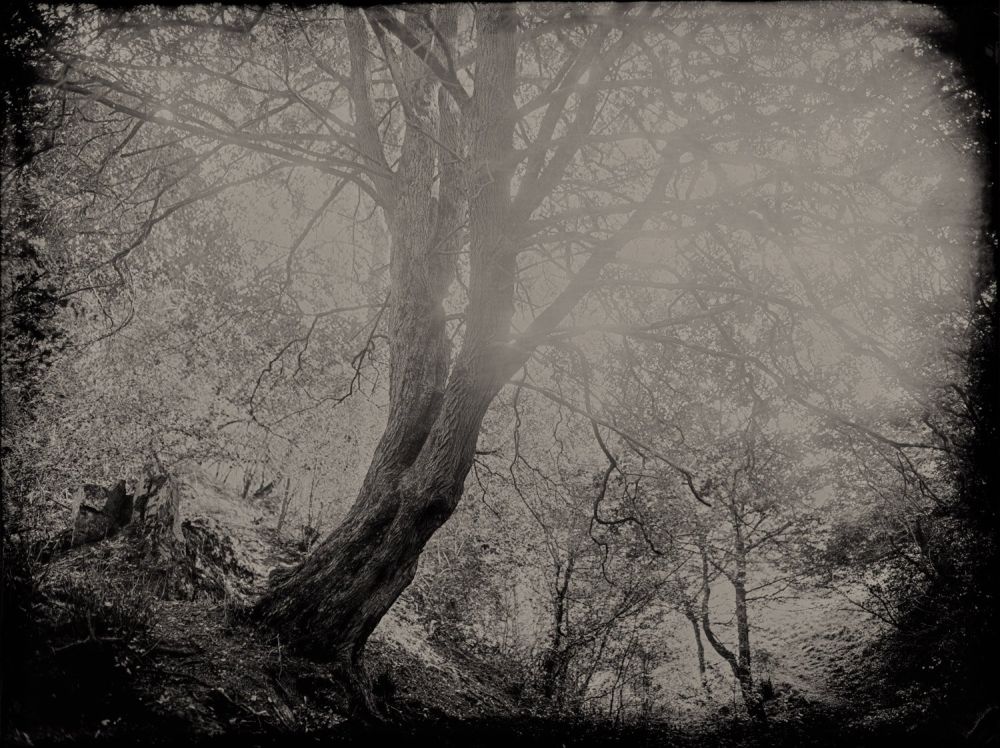
"Adorfer Klippen II"
wet plate collodion, original on aluminum plate (ferrotype)
In the middle of Germany, 42 places have been identified that have a special cultural, spiritual and historical significance. They are quiet places that touch and invite people to pause in these hectic times. A renowned trio of author (Michael Gleich), photographer (Christian Klant) and designer (Clemens Theobert Schedler) showcases these places with an elaborate book project.
Photographic artist Christian Klant spent three years working on this project. Klant is internationally known for his work with the historic collodion wet plate process. He deliberately chose this slow and mindful working method for „Places of Resonance“ as well. With large-format camera and darkroom tent, he traveled many times from Berlin to the „Sauerland Seelenorten“ (soul sites) to photograph rocks, springs, churches, majestic trees and even the gallery of an iron mine. His works have an intense and timeless effect. They represent a strong counterpoint to the everyday flood of images. WDR television produced two reports about his work on this project.
The texts by Michael Gleich, a Berlin-based author, presenter and curator who has his roots in the Sauerland region, offer a second perspective on the very same places. With philosophical depth and sensitivity, he describes not only meanings and backgrounds, but his own personal experiences. A detailed introduction to the subject and an inspiring portrait of Christian Klant’s working methods complement the contributions on the individual places.
Both perspectives are united by the examination of the resonance to these special places. As a result, the book itself also becomes a kind of soul site.
(christian-klant.com)
The 42 selected places, “Sauerland soul places”, are rocks and quarries, churches and hilltops, mighty trees and underground caves, lakes and valleys. Places that are particularly impressive and have a special meaning for the people in their surroundings. Not only today, but also in earlier times. They touch people emotionally, mentally and spiritually. They evoke strong resonances. They are places to which people wander and where they can switch off. To come to themselves. Enjoy the peace and quiet. Be inspired. Gain new insights. Even though every Sauerland Seelenort tells its own story, there is one quality that connects them all: Living silence. More about the soul places at www.sauerland-wanderdoerfer.de
“The Red Cliffs are a good place to let your inner child run free.”
(Michael Gleich)
The Adorf Cliff, also known as the Martenberg Cliff or Red Cliff, is a geological natural monument in the Diemelsee Nature Park in northern Hesse. The approximately 8-metre-high Martenberg Cliff is located in a former open-cast iron ore mine. Its geological structure dates back to the Devonian period, i.e. the early history of the earth from 393.3 to 358.9 million years ago, and is particularly rich in fossils. The rich red iron fauna consists of cephalopods (cephalopods), brachiopods (brachiopods), trilobites (three-lobed crustaceans), crinoids (crinoids), conodonts and solitary corals. The term “Adorf Stage” was coined for the first time at the beginning of the 20th century, and the Martenberg Cliff subsequently became the type locality and reference profile for the stratigraphic classification of the Devonian and the cradle of the globally valid cephalopod stratigraphy, i.e. the classification of fossil cephalopods.
Christian Klant works with the historical photographic technique of ferrotyping from the 19th century. This involves creating a direct positive image on a thin, black lacquered iron plate - contrary to the misleading name for this technique, tintype, the plate is not made of tin but of iron (Latin ferrum). Ferrotyping was developed in the 1850s and was a cheaper and more robust alternative to the earlier daguerreotype and ambrotype processes. During production, the iron plate is coated with a light-sensitive emulsion (usually collodion). The image is exposed and developed directly on this plate. However, the resulting negative image appears as a positive against a dark background due to the dark field principle. Each image is therefore unique.
This technique was particularly popular at the time for portraits, including at fairs, during the American Civil War and in street photography. Due to its low cost and quick production, it was accessible to a broad section of the population.
(Christoph Fuchs, translated by deepL)
S-2882, Front view
© Christian Klant