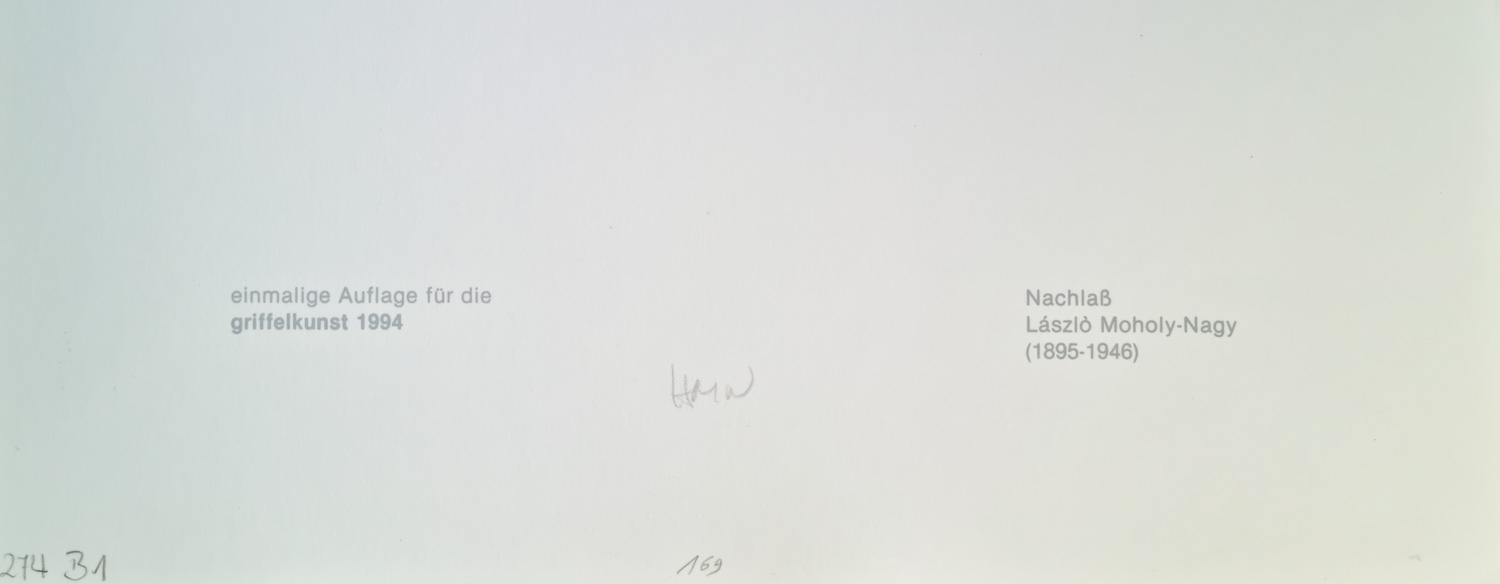
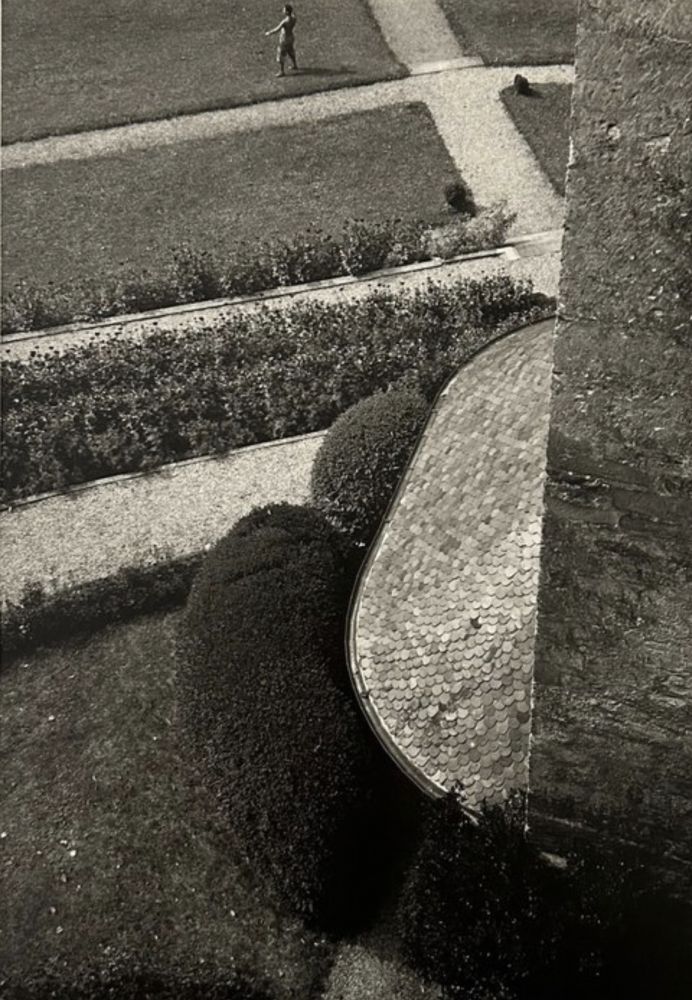
untitled
gelatin silver print
estate stamp on verso
László Moholy-Nagy was an autodidact. He first experimented with constructivism in painting. Through the inspirations of forms and geometries, as well as spatial depths, he quickly found his style, which eventually ran through all his works. In addition, Molholy was also a typographer, photomontographer and worked as a filmmaker. At the same time, he experimented with photography and photograms. For László Moholy-Nagy, the visual character and the properties of the material used in each case were in the foreground, which gave him important impulses at the Bauhaus. A political stance or realism were completely secondary for Lazlo.
Moholy's style was characterised in particular by his very graphic depictions. This graphic style was therefore also characteristic of his photographs. For him, photography was above all painting with light. By deliberately negating photographic rules, he achieved plunging lines and unprecedented perspectives.
His intention was to suspend perspective for the viewer and to convey a new view of the forms of the world. This intention is essentially reflected in the fact that he always tried to include the subject, i.e. the viewer, and to let him "fly", so to speak.
Moholy-Nagy: "Space is a reality, divisible according to its own laws, it must be grasped in its fundamental substance.... Spatial design is the design of positional relationships of bodies."
This schema runs through Moholy's entire design.
These lines of thought are essential to a style of photography that later became known as "New Seeing". As its name suggests, this shows a completely new way of seeing at the beginning of the 20th century. It makes use of "stylistic devices" such as experimental motifs, unconventional cropping, extreme perspectives, for example views from above or below, which in the photographic contra-compostion create a momentum of their own that can easily lead to bizarre movements of the picture elements and fantastic or even surreal appearances of things, and finally the fascination of freezing moving images, which was now possible through cameras.
Looking at all these stylistic devices, one quickly sees that for the representatives of the New Seeing, the aesthetics in the image almost always play a greater role than the content. No significance is attached to the content of the camera image. the objectivity of photography forces the viewer to form his or her own opinion. The camera is merely meant to complement the eye in its ability to see.
The connections Moholy aimed for between the pictorial elements lead almost automatically to the same mode of action as Surrealism, and Moholy seems to have been eager enough to discover that he took up and developed these aspects that now presented themselves. This surrealism is quite accepted and intended by Moholy, as various of his photographs show.
(Mats Karlsson, www.matskarlsson.de)
S-2603, Front view
S-2603, verso view