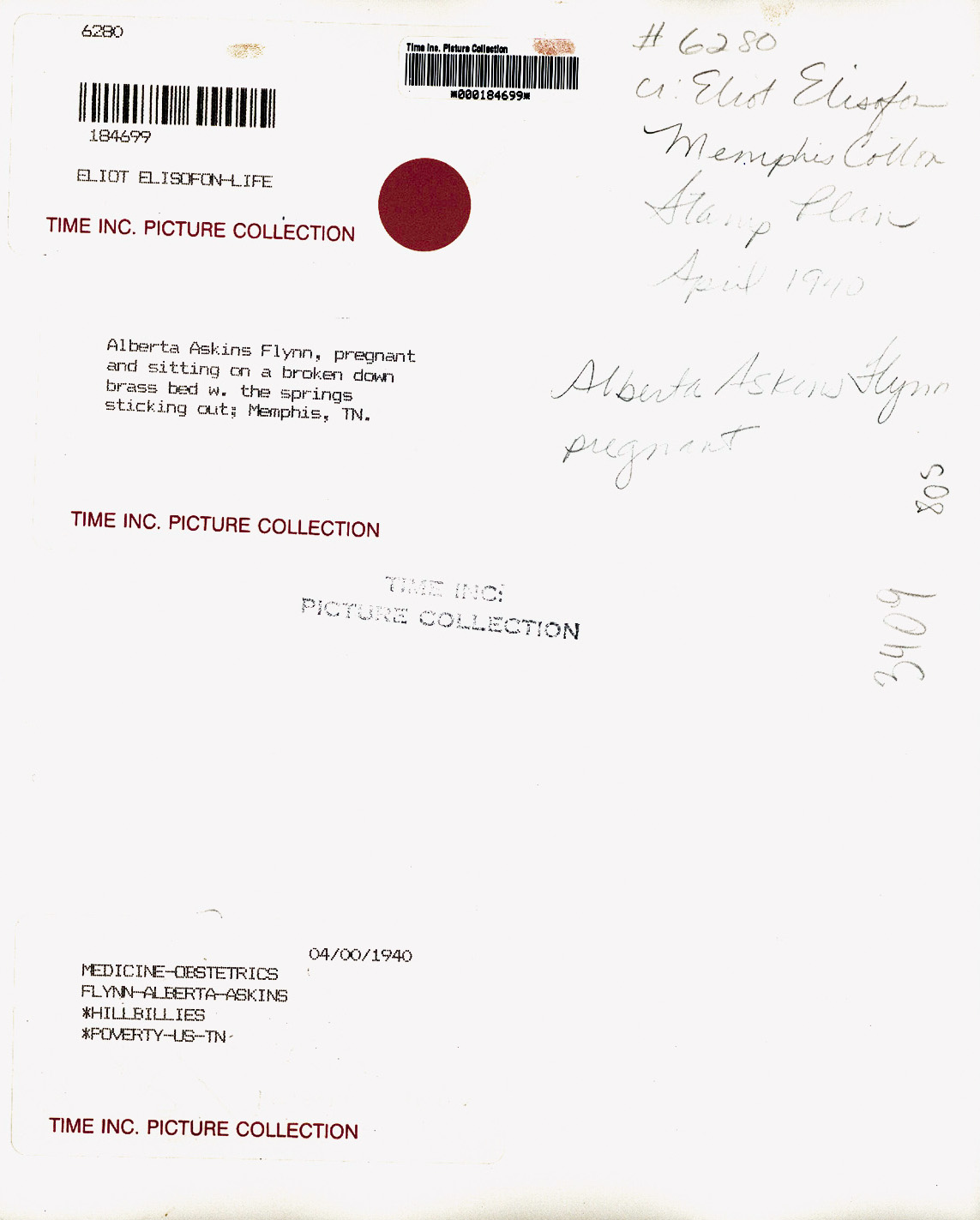
"Alberta Askins Flynn, pregnant and sitting on a broken down brass bed with the springs sticking out; Memphis, TN"
gelatin silver print
signed, dated (pencil) and titled on verso
Eliot Elisofon gained attention in the US in the 1930s and 1940s with his social documentary photographs. He was a member of the New York Photo League, an association of photographers who wanted to highlight social injustices and initiate political change, active from the end of the Great Depression to the beginning of the Cold War. Due to its left-wing orientation, the association came under scrutiny by the US government and was placed on the list of subversive organizations.
This photograph by Elisofon is also known as Memphis Child Bride. The portrait shows the pregnant Alberta Askins Flynn in a dilapidated room in Memphis, Tennessee. The picture was taken in 1940, in an America that was slowly beginning to recover economically from the shock of the Great Depression, but where social inequality was still deeply felt – especially in rural and African American communities in the South. Elisofon's work was closely related to the visual language of the Farm Security Administration (FSA), even though he himself was not a member of this program. The portrayal of Alberta Askins Flynn is far more than a mere social study: her calm, almost proud demeanor contrasts with the material hardship conveyed by the surroundings in the image. In this scene, pregnancy serves as a symbol of both vulnerability and hope – a future life that begins under difficult conditions. The authenticity of the scene speaks for itself – the camera does not function as a distant observer, but as an empathetic medium between subject and viewer.
(Christoph Fuchs)

S-1982, Front view
© Eliot Elisofon Photographic Archives, Washington
S-1982, verso view