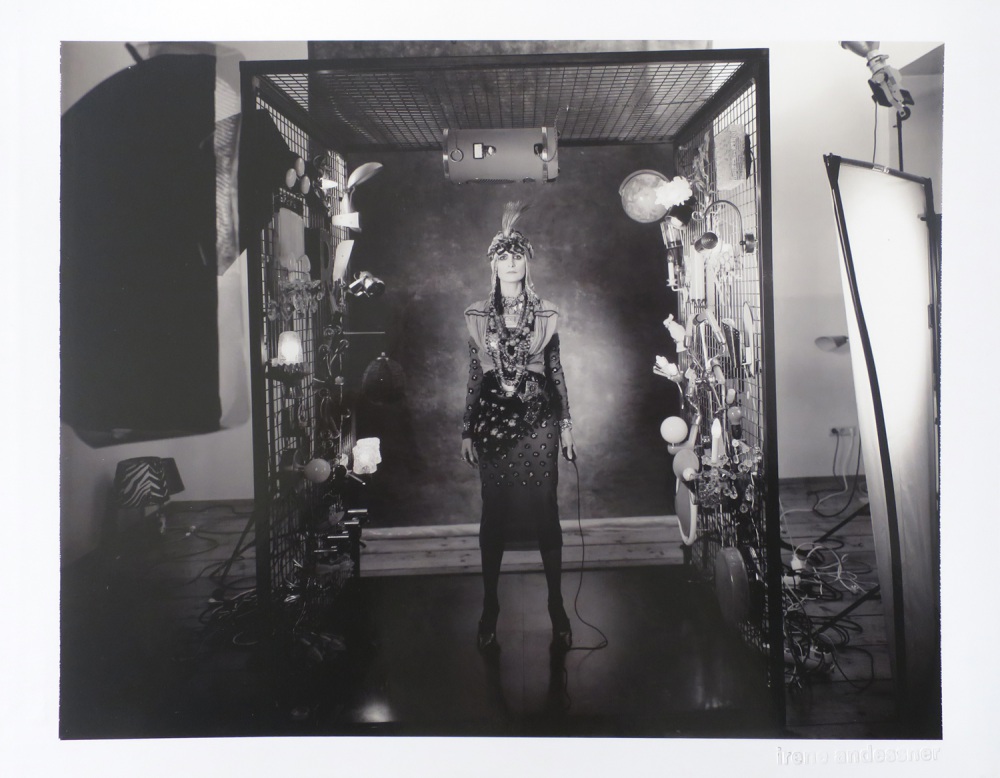
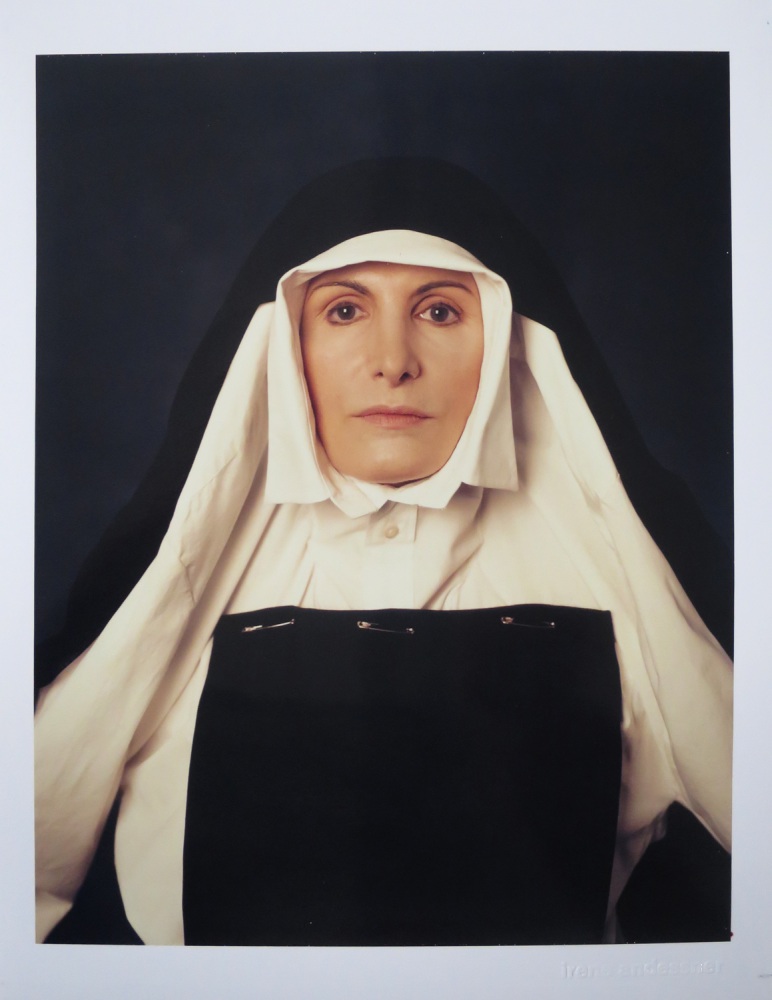
"Marietta Robusti"
instant photograph (Polaroid)
signed, titled, dated and numbered on verso
Marietta Robusti (1554-1590)
The Tintoretta
As is known, Tintoretto’s real name was Jacopo Robusti. The painter, fond of his daughter Marietta, the favourite of his eight children, dressed the girl as a boy in order to bring her with him wherever he went so that she might be educated in the many aspects of his work. Marietta learned from her father the secrets of drawing and painting and soon revealed herself, like her brothers Domenico and Marco, worthy of working with their famous father. From 1580 onwards the master’s daughter was famous for her portraits, to the point that posing for the “Tintoretta” became a fashion of the Venetian nobility. Marietta’s love of her father would cause her to refuse invitations to the prestigious courts of Spain and Austria who wished her to be their court portraitist. In 1586 she agreed to marry the jeweller Jacopo d’Augusta, on the sole condition that they live in her paternal house. After fifteen years of work in Tintoretto’s studio, her painting technique was difficultly distinguishable from that of her father’s, which led her works to be con- fused with those of the Master. Only in 1920 were the marks “M” or “MR” discovered in some of Tintoretto’s paintings. Today we know that the hand of Marietta played its part in the creation of “Vecchio con fanciullo”, considered to be one of Tintoretto’s best portraits. When, four years before Tintoretto’s death, Marietta died of complications in the birth of her first child, it is said that the great Master’s work saw a considerable decline in quality.
Donne Illustri
Caffà Florian on St Mark’s Square in Venice: in the “Sala degli Uomini Illustri” (salon of famous men) hang ten oil paintings by Giulio Carlini (1826–1887). Irene Andessner confronts these posthumously painted portraits of famous Venetians – from Marco Polo via Titian to Goldoni – with ten Venetian women, among them the city’s most famous composer (Barbara Strozzi) and painter (Rosalba Carriera) and the most expensive courtesan (Veronica Franco), as well as the first female doctor (Elena Lucrezia Cornaro Piscopia) and the world’s first female lawyer (Moderata Fonte). Through this intervention the Sala degli Uomini Illustri is transformed into the Sala delle Donne Illustri (salon of famous women). A picture puzzle-like disturbance: disregarding make-up, wardrobe, light, decoration and pictorial detail, Andessner’s portrayals differ from the historical picture references of the ten female figures in that she has not copied the bearing and look of the women, but rather of the men from the portraits hanging above. Thus the self-perception, the pre-potency of the male counterparts is broken.
A further room, the Saletta Liberty, is turned into the “Moderata Fonte Room” with a Fonte/Andessner photographic full-length self-portrait in a light box. Opposite this portrait Andessner places a “Fonte” portrait painted in oil on canvas, for which she sat as model in the workshop of Marinella Biscaro.
“7 Gentildonne”: as a preliminary to the exhibition Andessner convenes a meeting of seven Italians in the Caffà Florian men’s salon – inspired by Moderata Fonte’s debate in the novel “Verdienst der Frauen” [merit of women], documented as a video work. In the photo production for the Venice project there are additional full-length portraits, which transpose into our time the historicised portrayals of women (only visible in oval bust details in the room installation) by means of complete styling. In these images it can also be seen that the artist has the camera shutter release in her hand; which means – in contrast to earlier productions – she releases the image herself in just that moment when she herself inwardly feels the particular role so fully that she is sure she is bringing the personality of that model woman perfectly to expression. This way of working corresponds to the historical Venetian women, who likewise developed and lived out their professions self-determined and self-employed, independent of men. The full-length self-portraits are executed as light boxes.
The “Donne Illustri” project, curated by Stefano Stipitivich, takes place under the auspices of the Art Programme of the Caffà Florian. Started over 15 years ago by the caf» owner and art collector Daniela Gaddo Vedaldi, the series of exhibitions has so far represented artists such as Mimmo Rotella (1990), Fabrizio Plessi (1993 and 2001) and Luca Buvoli (1997)

S-1802, Front view
© Irene Andessner

S-1802, verso


© Irene Andessner

© Irene Andessner

© Irene Andessner


© Irene Andessner