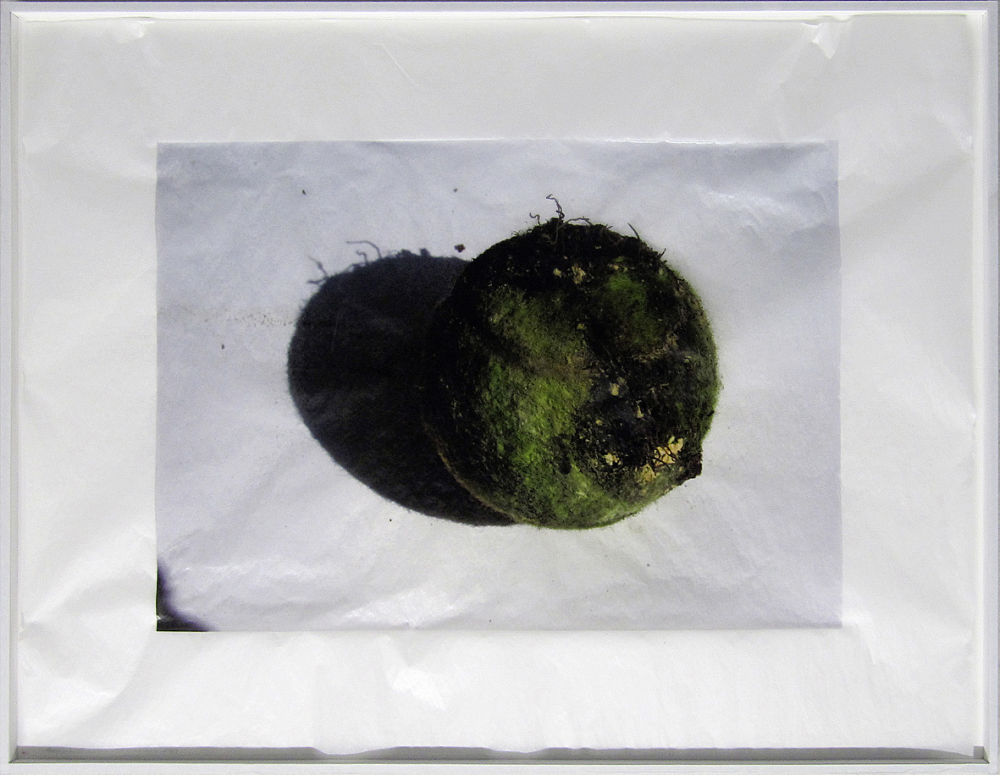
"tennis-earth.ball"
WAL/D 102
MUD print on Japanese paper / unique multiple transfer print (UMT)
The fragile prints on wafer-thin Japanese paper were developed by the artist himself in a long process. The printing process, also known as MUD-Print because it works with mud, is based on digital technology and changing "recipes" of ingredients such as polymers and colloids. The ingredients are constantly mixed in new recipes. Martin Walde works like in a chemistry lab and knows how to use his results optimally for artistic purposes. He focuses on the special characteristics of the materials and observes how they change and deform during chemical and technical interventions. MUD prints are lightfast inkjet prints that combine photographic and analogue elements. All information is enclosed in transparent layers. Control over the content is kept by the unpredictable mixing of substances, beyond an industrially standardized methodology. Content is discarded, darkness and light use different manifestations of materiality. Thus each print receives its unrestrained individual appearance. The impression of sculptural form and the extreme materiality of the information move Mud$Prints away from the medium of "photography" and let them become objects. Peter Weiermair calls them UMT-Prints - unique multiple transfer printing. In the second room there are two seated figures. They are wax models of a woman (Choice, 1995) and a man (Multiple-Choice, 2013), which are reduced in scale. The surface is soft and transparent like alabaster. In 2013 Martin Walde showed a version of Multiple-Choice at the Art Parcours of Art Basel. The figures stand in a dark room and only the presence of people makes them appear for a short time. A motion detector triggers an intensive but short irradiation of the figure by an infrared lamp. In the short glow we see the seated persons, who hold their arms and hands protectively in front of their faces. The heat of the IR_lamp is a threat to the materiality of the viscous waxes. In these works, the material is not instrumentalized as a traditional Ready Made quotation of the Burning Sculpture, but is used for its performative qualities.
(Arthur Koestler, Darkness at Noon, 2014)
S-1578, Front view
© Martin Walde