

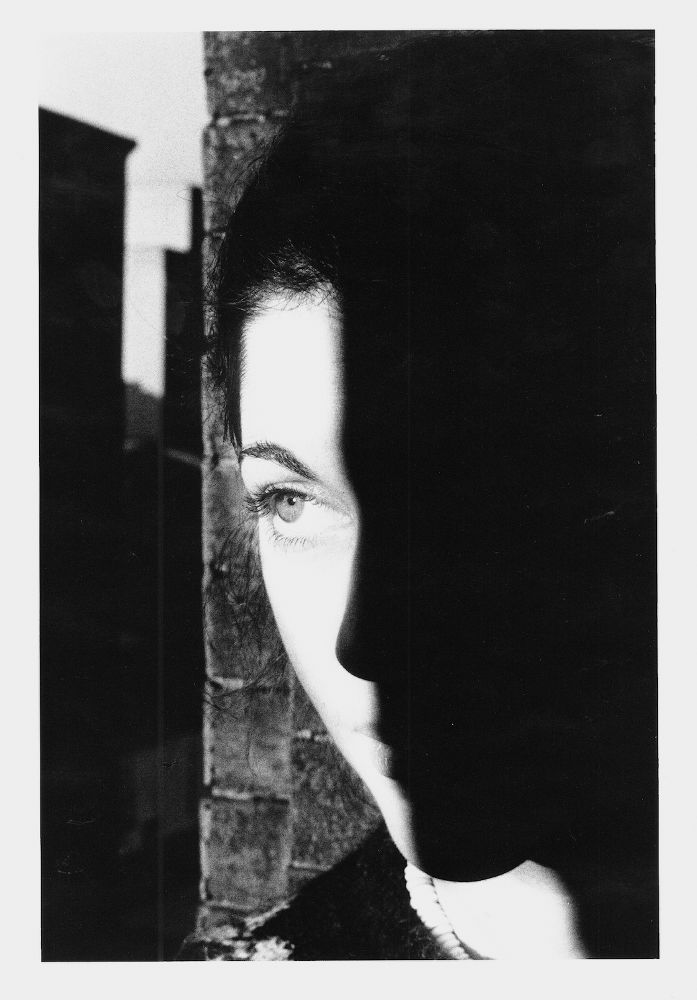
"Christine"
gelatin silver print
signed and dated (pencil) on verso
Ralph Gibson is one of the central figures of post-war American photographic art and is particularly known for his surrealist black-and-white images. As the son of the Hollywood film industry (his father was assistant director to Alfred Hitchcock), Gibson's early exposure to film sets sparked his passion for photography. He studied photography during his time in the US Navy and at the San Francisco Art Institute. He worked with important photographers such as Dorothea Lange and Robert Frank. Early on, he turned away from the documentary tradition and developed a highly subjective, symbolically charged visual language characterized by light-shadow contrasts, fragmentation, and formal reduction.
The strictly composed portrait Christine shows a young girl in half profile, her face precisely divided in two by light and shadow. Only one eye remains visible in the light – alert, vulnerable, and at the same time mysteriously distant. Typical of Gibson's work is the strong graphic reduction: black and white, form and fragment, suggestion instead of clarity.
“I am fascinated by the alchemical process of light and film,”1 says Gibson. He sees the medium of photography not as a mere reflection of reality, but as an instrument of inner insight.
The division of the face into light and shadow can thus be read as a symbol of a split identity, as in the period of growing up, which Gibson deals with in the series Infantia. Gibson is known for his subtle, almost mystical eroticism, which here too conveys closeness (the face is very close) and at the same time a great distance (it remains partly in darkness, unrecognizable) – this creates tension.
(Christoph Fuchs, translated with deepL, 2025)
Note
1
Ralph Gibson, quoted in Die Zeit, June 18, 2012, https://www.zeit.de/kultur/kunst/2012-06/fs-ralph-gibson-2 (accessed July 12, 2025)
S-0015, Front view
© Ralph Gibson
S-0015, Back view

S-0015, Vergl. Herbert Bayer, „Profil en face“, 1929, S-1203