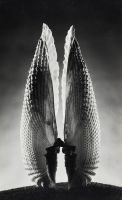
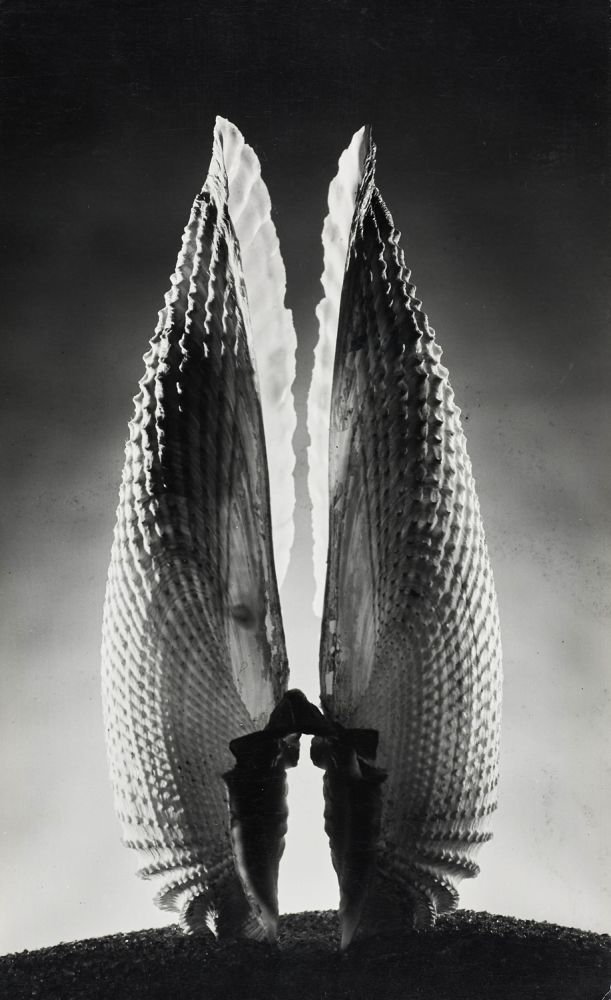
"Two Shells"
(14 S)
gelatin silver print on cardboard
signed, titled and dated (pencil) by Cole Weston on verso
1927, Monday Morning, Los Angeles
I worked all Sunday with shells, – literally all day. Only three negatives made and two of them were done as records of movements, to repeat again when I can find suitable backgrounds. I wore myself out trying every conceivable texture and tone for grounds: glass, tin, cardboard, – wool, velvet, even my rubber rain coat! I did not need to make these records for memory's sake, – no, they are safely recorded there. I did wish to study the tin which was perfect with the lens open: but stopped down I could not see sufficiently to tell, but was positive the surface would come into focus and show a network of scratches: it did. My first photograph of the Chambered Nautilus done at Henry's [Henrietta Shore, painter] was perfect all but the too black ground: yesterday the only available texture was white. Again I recorded to study at leisure the contrast. The feeling of course has been quite changed, – the luminosity of the shell seen against the black, gone: but the new negative has a delicate beauty of its own. I had heart failure several times yesterday when the shells, balanced together, slipped. I must buy a Nautilus for to break Henry's would be tragic.
(Edward Weston)1
[…] In the beginning of his career Weston, like many other photographers, used his camera to earn his livelihood. His commercial portraits were excellent, but they were made to please his subjects, not himself, and perhaps in rebellion against the demands of his clients he began to assert his own artistic sensibilities. Some of his early pictures seem almost to insist upon recognition as works of art - and many of them are, but within a context made familiar by other media. Such photographs as Prologue to a Sad Spring, 1920, and Johan Hagemeyer, 1925, are elegantly composed and executed, but the compositions do not seem to arise out of the necessities of the subjects. One is reminded of Whistlerian composition and Japanese prints.
In 1922 Weston exhibited his photographs in Mexico City, where they were enthusiastically received, and in 1923 he moved to Mexico, intending to live and work there. During his stay he became friends with the Mexican artists of the revolutionary period: Diego Rivera, Carlos Merida, Jose Clemente Orozco, and Jean Chariot. Paradoxically, these painters' appreciative discussion of his work did much to liberate his photographs from painterly influences, and this liberation was encouraged by his discovery of the unselfconsciousness in folk art.
As he became more secure he was able to present his subjects with a minimum of the literary content that characterized his earlier work. He found radical ways of making pictures. His approach became basic, simple, forthright. One example is his assertive boldness in presenting the nude in Mexico, D.F., 1925. This symmetrical composition represents a distinct departure from the mode of Prologue to a Sad Spring. The direct deliverance of the subject is deceptively simple; it challenges the viewer to make his own interpretation. In his new pictures, the object is all there, complete within the confines of the frame; it is clearly what it is, a shell, a pepper, a woman's body. Yet it is more. Whatever it may be, it also partakes of all other things because Weston saw its universal qualities. Throughout his life Weston found forms that are repeated in nature (Cloud over the Panamints, Death Valley, 1937; Shell, 1927), Even a casual reviewer recognizes that he saw relationships between rocks, clouds, vegetables, shells, sand dunes, the human body. […]
(Willard Van Dyke)2
Notes
1
Nancy Newhall (ed.), Edward Weston, Photographer. The flame of recognition: his photographs, accompanied by excerpts from the daybooks & letters, Aperture New York 1975, p. 21
2
Willard Van Dyke (director of the exhibition), press release, Edward Weston, exh. Jan 29–Mar 30, 1975, MoMA, New York, https://www.moma.org/calendar/exhibitions/2502

S-1281, Front view
© Center for Creative Photography, Arizona Board of Regents

S-1281, Back view
© Center for Creative Photography, Arizona Board of Regents